

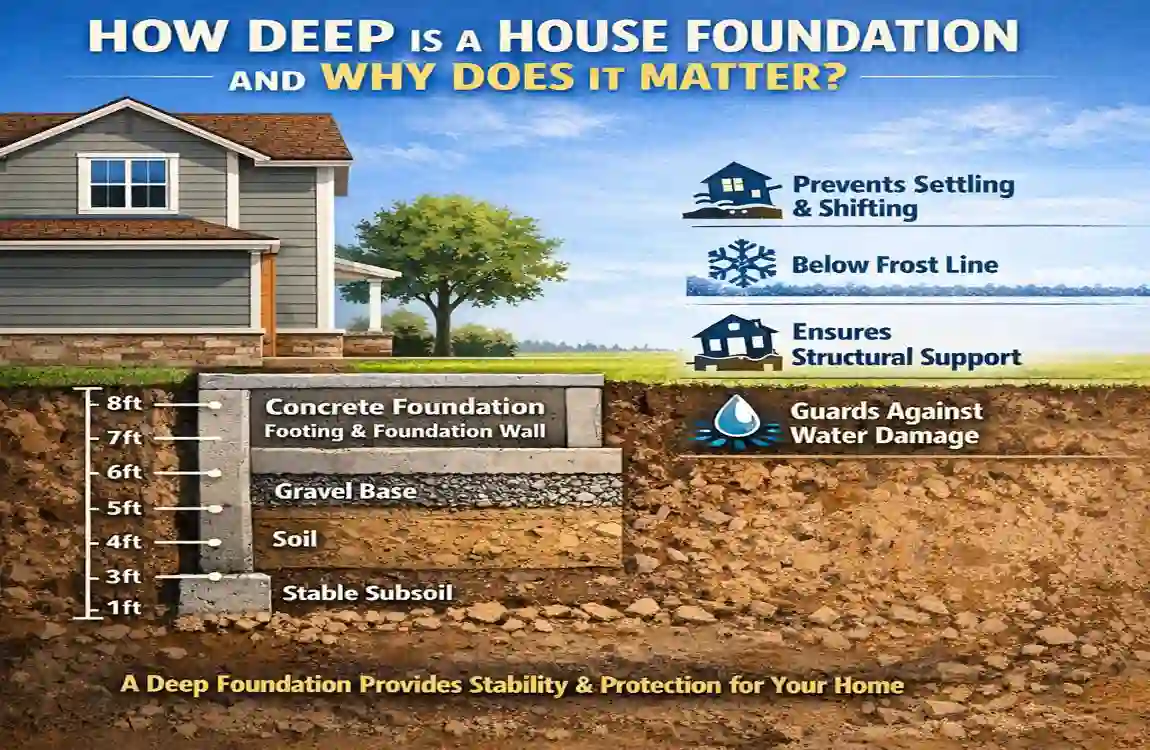
When you look at a house, you usually notice the above-ground features first. You see the walls, roof, windows, and front door. But what holds all of that up is hidden below the surface. That hidden base is the foundation, and it does far more work than most people realize.
If you have ever asked how deep a house foundation is, you are asking a very smart question. Foundation depth affects how stable a home is, how well it handles weather, how long it lasts, and even how much it costs to build or repair. It is one of those construction details that may seem invisible, but it has a huge effect on the safety and strength of the whole house.
The right depth depends on several things, including soil type, climate, frost line, building design, and local building codes. That is why there is no single number that fits every house. Some homes sit on shallow slab foundations, while others need deeper basements or piers that reach much farther into the ground.
What Is a House Foundation?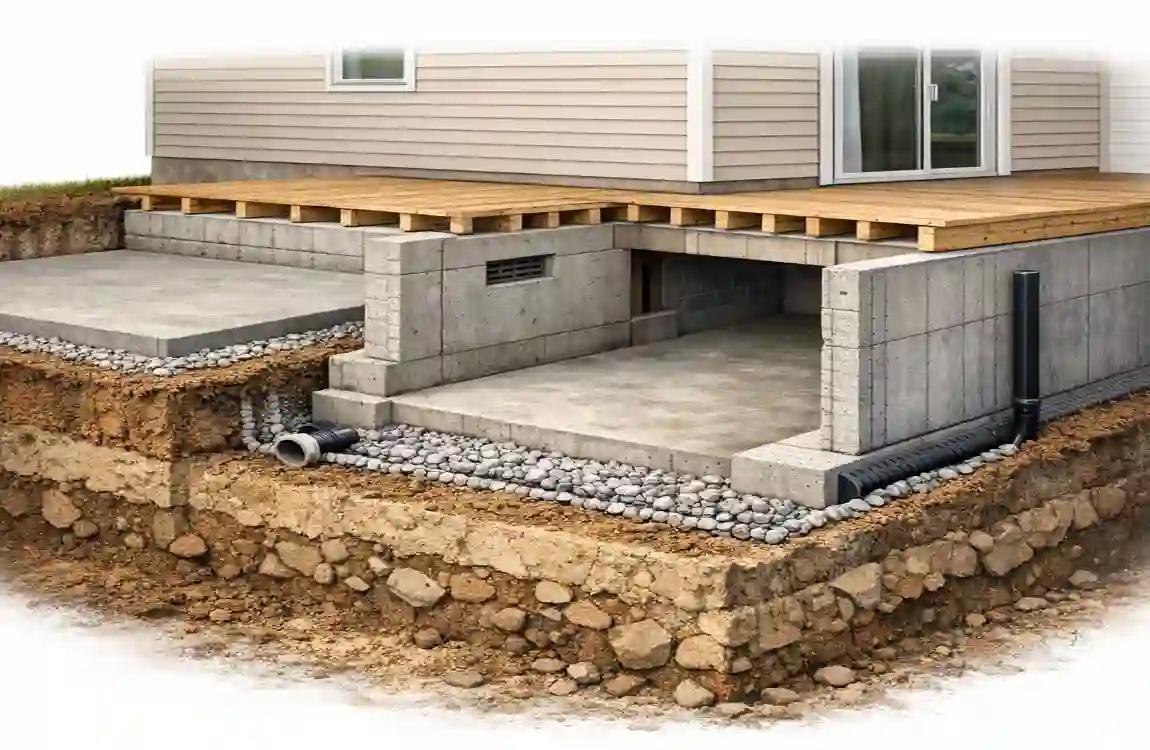
Basic definition of a foundation
A house foundation is the structural base that supports the entire home. It sits between the building and the ground, helping transfer the house’s weight safely into the soil below.
That may sound simple, but it is one of the most important parts of construction. Without a strong foundation, the house would settle unevenly, crack, tilt, or even fail over time. The foundation acts like the anchor of the home. It keeps everything stable.
A good foundation does more than hold up the structure. It also helps protect the house from moisture, movement, and ground pressure. In many cases, it also provides a barrier between the home and shifting soil or changing weather conditions.
Main types of foundations
Most homes use one of three common foundation types:
Slab foundation
A slab foundation is a flat concrete base poured directly on the ground. It is common in warmer climates and is usually the shallowest type.
Crawl space foundation
A crawl space foundation raises the home slightly above the ground, leaving a small space underneath. This area allows access to plumbing, electrical, and other systems.
Basement foundation
A basement foundation goes deeper into the ground and creates a full or partial lower level beneath the home. This is often the deepest type of residential foundation.
Each type has its own depth range, purpose, and cost. The foundation style also affects how the home handles climate, soil movement, and water.
Why does the foundation type affect depth
The type of foundation matters because different homes need different levels of support. A foundation is not built to the same depth everywhere. Builders must consider:
- Soil conditions
- Climate
- House size
- Building materials
- Local code requirements
For example, a house in a cold climate may need deeper footings to sit below the frost line. A home in a warm, dry region may safely use a shallower slab. A larger or heavier house may also require a stronger, deeper support system.
So when you ask how deep a house foundation is, the answer begins with the type of foundation itself.
How Deep Is a House Foundation on Average?
Typical foundation depth range
There is no single standard depth for every house foundation, but there are common ranges.
In general:
- Shallow foundations: about 12 inches to 4 feet
- Deep foundations: about 8 feet to 50+ feet for special support systems like piles or columns
Most residential homes do not require foundations that extend to extreme depths. Those very deep systems are more common in large buildings, on unstable ground, or in special engineering projects.
For a typical house, the depth is usually measured by the footing depth, basement depth, or the depth below the frost line. The total answer depends on the design and site conditions.
Depth by foundation type
Slab foundations
Slab foundations are generally the shallowest. The concrete slab itself may be only 3 to 6 inches thick. In comparison, the footings around it may extend 12 to 24 inches or more, depending on the home and soil conditions.
Crawl space foundations
Crawl space foundations usually sit deeper than slab foundations but shallower than basement foundations. They often extend around 18 inches to 4 feet below grade, depending on design and access needs.
Basement foundations
Basement foundations are usually the deepest standard residential foundations. A full basement may go about 8 to 10 feet deep, sometimes more if the home is built on a slope or if the design requires extra headroom.
Regional differences
Where you live has a big impact on foundation depth.
Cold climates
In colder regions, foundations must usually extend below the frost line. This helps prevent the ground beneath the house from freezing and pushing the foundation upward. In these areas, the foundation may need to be deeper than it would be elsewhere.
Warm climates
In warmer climates, frost is less of a concern, so shallow foundations are often acceptable. That is why slab foundations are very common in places with mild winters.
A simple answer to the focus keyword
So, how deep is a house foundation? The short answer is: it depends. Many homes use shallow footings around 1 to 4 feet deep, while basements may go 8 to 10 feet deep or more. Special structures may go much deeper.
The exact number is less important than ensuring the foundation is deep enough for the soil, climate, and the house’s design.
Factors That Determine Foundation Depth
Soil type and stability
Soil is one of the biggest factors in foundation design. A foundation must rest on ground that can safely carry the weight of the house without shifting too much.
Different soils behave differently:
Clay soil
Clay expands when wet and shrinks when dry. That movement can put stress on foundations. Homes built on clay may require deeper footings or additional support to reduce shifting.
Sandy soil
Sandy soil drains well, but it may not always be very strong on its own. Builders may need to go deeper or widen footings to create stability.
Rocky soil
Rocky soil can be very strong, but it may be uneven or hard to excavate. That can affect how deep and how easily a foundation is built.
Soft or loose soil
Loose or weak soil may not support a home well unless the foundation reaches firmer ground below it. In these cases, deeper foundations may be needed.
The stronger and more stable the soil, the more likely a standard depth will work. Weak or shifting soil often requires more engineering.
Frost line depth
The frost line is the depth in the ground where freezing temperatures no longer reach during winter. This matters because when soil freezes, it expands. That expansion can push a foundation upward, a problem called frost heave.
Builders usually place the footing below the frost line so the foundation sits on stable ground that will not freeze and shift.
This is especially important in cold regions. If the foundation is too shallow, winter conditions can damage the home over time.
Building weight and design
The weight of the home also affects foundation depth.
A small single-story home places less load on the foundation than a large two-story house. Heavier materials such as brick, stone, or concrete add more weight, too.
The foundation must be deep and strong enough to support safely:
- The number of stories
- The roof load
- The wall materials
- Interior finishes
- Furniture and occupancy load
A heavier house often needs deeper footings or stronger support to distribute weight properly.
Water table level
The water table is the level at which the ground becomes saturated with water. If the water table is high, building a deep foundation can become more complicated.
A high water table can cause:
- Flooding in basements
- Damp crawl spaces
- Soil instability
- Drainage issues
- Pressure against foundation walls
In these cases, builders may need to adjust the design or use drainage systems to keep the foundation dry and stable.
Local building codes
Local building codes govern many aspects of foundation design, including minimum depth requirements. These rules are based on safety, climate, and engineering standards.
Builders must follow these rules when constructing a home. Codes may specify:
- Minimum footing depth
- Frost line requirements
- Reinforcement standards
- Drainage requirements
- Soil testing expectations
This means the answer to how deep a house foundation should be is not just a matter of preference. Legal and safety rules in your area also shape it.
Types of House Foundations and Their Depths Explained
Slab-on-grade foundation
A slab-on-grade foundation is one of the most common and cost-effective foundation types. It consists of a concrete slab poured directly on the ground with thickened edges or footings around the perimeter.
Typical depth:
- Slab thickness: 3 to 6 inches
- Footings: often 12 to 24 inches deep, sometimes more depending on local conditions
This type is popular in warm regions because it is simple, fast, and less expensive than deeper systems. It also works well where frost is not a major issue.
However, slab foundations can make plumbing repairs more difficult because pipes are often embedded in or beneath the slab.
Crawl space foundation
A crawl space foundation raises the house slightly above the ground and creates a low space beneath it. This space may be just large enough for a person to crawl through for maintenance.
Typical depth:
- About 18 inches to 4 feet below grade, depending on the design
This type offers access to plumbing, wiring, and ductwork. It can also help with ventilation and moisture control in some climates.
Crawl spaces are useful in areas with moderate moisture or uneven terrain. Still, they require proper sealing and drainage to prevent mold and pests.
Basement foundation
A basement foundation goes deeper and creates a full lower level. Basements are common in colder regions and in homes that need extra usable space.
Typical depth:
- About 8 to 10 feet deep for a standard residential basement
- May be deeper depending on ceiling height and design
A basement foundation provides the home with additional living, storage, or utility space. It also provides excellent structural support when built correctly.
But it usually costs more because it requires more excavation, more materials, and more waterproofing.
Pier and beam foundation
A pier and beam foundation uses vertical concrete piers or columns to support the house above ground. This type is often used in areas with difficult soil conditions or where homes need to be elevated.
Typical depth:
- Concrete piers may extend 5 to 20+ feet depending on soil and structural needs
These foundations are useful in flood-prone areas or on sloped land. They allow air movement underneath the house and can make repairs easier in some cases.
Quick comparison table
Foundation TypeTypical DepthCommon UseMain Advantage
Slab-on-grade 3–6 in slab, 12–24 in footings Warm climates Low cost and simple construction
Crawl space 18 in–4 ft Moderate climates Access to utilities
Basement 8–10 ft+ Cold climates, extra space Strong support and usable lower level
Pier and beam 5–20+ ft piers Uneven or flood-prone areas Elevation and flexibility
Which foundation is deepest?
Among standard home foundations, the basement foundation is usually the deepest. But in difficult soil conditions, pier systems can go even deeper than basements. So again, the real answer to how deep a house foundation should be depends on the home and site.
Why Foundation Depth Matters for Your Home
Structural stability
The biggest reason foundation depth matters is stability. A house must sit on ground that can handle its weight without shifting, sinking, or cracking.
If the foundation is too shallow or poorly designed, the house may move unevenly over time. That can lead to major structural problems.
A proper foundation helps keep the walls straight, the floors level, and the roof aligned. Without that support, everything else becomes less reliable.
Protection from weather
Foundation depth also protects the home from weather-related problems.
Frost heave
In cold climates, freezing soil can push against a shallow foundation. That movement can crack concrete and damage the structure.
Flood resistance
In some areas, a deeper or raised foundation can help protect the home from standing water or flood-related damage. While depth alone does not solve flooding, it is part of a stronger overall design.
Moisture control
A well-designed foundation also helps keep water out of the house. That matters for basements, crawl spaces, and any structure sitting near wet ground.
Longevity of the building
A home with a properly built foundation usually lasts longer with fewer major issues. That is because the foundation reduces movement and stress on the structure.
Think of it this way: a house may look fine above ground, but if the foundation is weak, the building will slowly lose its strength. A good foundation is one of the best long-term investments you can make.
Cost implications
Deeper foundations cost more upfront, but they can save money later.
A shallow foundation might be cheaper to build, but if it is not suited to the site, it can lead to expensive repairs. Cracks, water damage, settlement, and structural movement are all costly to fix.
So when you think about how deep a house foundation is, do not look only at the upfront cost. Also, think about future protection and repair savings.
Signs of an Improperly Deep or Weak Foundation
Cracks in walls and floors
One of the most common warning signs is cracking. Small hairline cracks may not always be serious, but larger or widening cracks can point to foundation movement.
Watch for:
- Cracks near doors and windows
- Cracks in interior drywall
- Cracks in basement walls
- Cracks in tile or concrete floors
If cracks keep growing, the foundation may need professional attention.
Uneven or sloping floors
If a floor feels like it tilts or dips in some areas, that may mean the foundation is settling unevenly. This is a serious sign because the building should sit level.
You may notice furniture wobbling or balls rolling slightly across the floor. Those can be early clues that something is not right.
Sticking doors and windows
When a foundation shifts, the house’s frame can change shape slightly. That may cause doors and windows to stick, jam, or fail to close properly.
This is often one of the first signs homeowners notice. It can seem like a small annoyance at first, but it may point to a bigger structural issue.
Water leakage in the basement or crawl space
Water in the basement or crawl space can mean poor drainage, weak sealing, or foundation problems. It may also suggest that the foundation is not deep or sufficiently protected for the conditions around the home.
Water damage should never be ignored. It can weaken materials, attract mold, and create long-term repair costs.
How Builders Decide Foundation Depth
Soil testing (geotechnical survey)
Before construction begins, builders often test the soil. This is called a geotechnical survey or soil test.
The goal is to learn:
- How strong the soil is
- How much moisture does it hold
- Whether it is stable
- Whether deeper support is needed
This is one of the most important steps in deciding foundation depth. Without soil testing, builders would be guessing.
Engineering design plans
Structural engineers use the soil data, house design, and code requirements to decide how deep the foundation should be. They calculate the loads and ensure the foundation can support them safely.
These plans are especially important for larger homes, sloped lots, or areas with difficult soil.
Local climate data
Builders also study local weather conditions. If the area has freezing winters, the foundation must usually go below the frost line. If the area is hot and dry, a shallower foundation may work.
Climate helps determine how the foundation should perform over time.
Budget and construction requirements
Of course, cost matters too. A deeper foundation requires more digging, labor, and materials.
But builders must balance budget with safety. Saving money by building too shallow can create serious problems later. A good builder looks for the best long-term value, not just the lowest starting price.
Cost Impact of Foundation Depth
Shallow foundations
Shallow foundations usually cost less because they require less excavation and fewer materials. This makes them attractive for budget-conscious projects, especially in warm regions with stable soil.
They are often the most affordable option when the site conditions are right.
Deep foundations
Deeper foundations cost more because they involve more labor, more concrete, more reinforcement, and sometimes waterproofing or drainage systems.
Basements and pier systems are usually more expensive than slabs. But they may also provide more usable space and better protection.
Repair costs vs proper installation
A properly built foundation may cost more at first, but it often reduces future repair expenses. That is the key tradeoff.
A cheap foundation that fails later can become a very expensive problem. So, when deciding how deep a house foundation should be, it is wise to consider more than the initial price tag.
Expert Tips for Homeowners Before Building
If you are planning to build a home, use these practical tips before construction begins:
- Always request soil testing reports
- Hire a licensed structural engineer
- Compare foundation types before choosing one
- Check local building codes carefully
- Do not cut corners on depth to save money
- Ask about drainage and waterproofing
- Plan for future repairs and utility access
These steps can help you avoid major structural problems later. A house is a long-term investment, and the foundation is where that investment truly begins.
Frequently Asked Questions
How deep is a house foundation typically?
A typical house foundation may range from 12 inches to 4 feet for shallow systems. In contrast, basement foundations often extend 8 to 10 feet or more deep. The exact depth depends on soil, climate, and foundation type.
What happens if a foundation is too shallow?
If a foundation is too shallow, it may shift, crack, or be damaged by frost heave, moisture, or soil movement. Over time, this can cause serious structural problems in the home.
Can foundation depth be changed after construction?
Not easily. Foundation depth is set during construction, and changing it later usually requires major repair work, reinforcement, or rebuilding. That is why planning the right depth early is so important.
Do all houses need deep foundations?
No, not all houses need deep foundations. Many homes do well with shallow slabs or crawl spaces, especially in warm climates with stable soil. The right depth depends on local conditions and design.
What is the strongest type of foundation?
There is no single answer for every situation. Still, deep basement foundations and deep pier systems are often considered among the strongest because they provide substantial support and better stability in challenging conditions.
Is a deeper foundation always better?
Not always. A deeper foundation is not automatically better if the site does not require it. The best foundation is the one that matches the soil, climate, and structure of the home. Overbuilding can add cost without adding real benefit.
Who decides how deep a house foundation should be?
Usually, the decision comes from a combination of the builder, structural engineer, soil report, and local building code requirements. It is a technical decision, not a guess.
| Aspect | Typical Details | Why It Matters |
|---|---|---|
| Shallow Foundations | 1 to 3 feet deep (0.3–1 meter) | Used for small homes on stable soil; cost-effective but less suited for heavy loads |
| Standard Residential Foundations | 3 to 8 feet deep (1–2.5 meters) | Most common depth for houses; balances stability and cost |
| Deep Foundations | 8 to 50+ feet (2.5–15+ meters) | Required for weak soil, high-rise homes, or flood-prone areas |
| Frost Line Consideration | Below local frost depth (varies by region) | Prevents cracking from freeze-thaw cycles |
| Soil Type Impact | Clay, sand, or rock affects depth needs | Ensures long-term structural safety |
| Load of Structure | Heavier homes need deeper support | Prevents settling and foundation failure |
| Water Table Level | Must be above or protected from groundwater | Avoids water damage and shifting |
