

Have you ever walked into a bedroom and instantly felt a wave of calm wash over you? The air feels breathable, the furniture sits perfectly in its place, and the room feels right. That feeling is not an accident. It is the direct result of careful planning and perfect sizing. Your primary bedroom is much more than just a place to close your eyes at night. It is your personal retreat, your quiet escape from a busy household, and the very first space you see when you wake up to start a new day.
Because we spend about a third of our lives sleeping, the dimensions of your sleeping quarters play a massive role in your overall well-being. A room that is too small can feel deeply suffocating and stressful. At the same time, one that is too large can feel cold, echoy, and unwelcoming. Furthermore, if you ever plan to sell your house, the primary suite is among the top three rooms potential buyers scrutinize. A perfectly proportioned suite can significantly boost your home’s resale value.
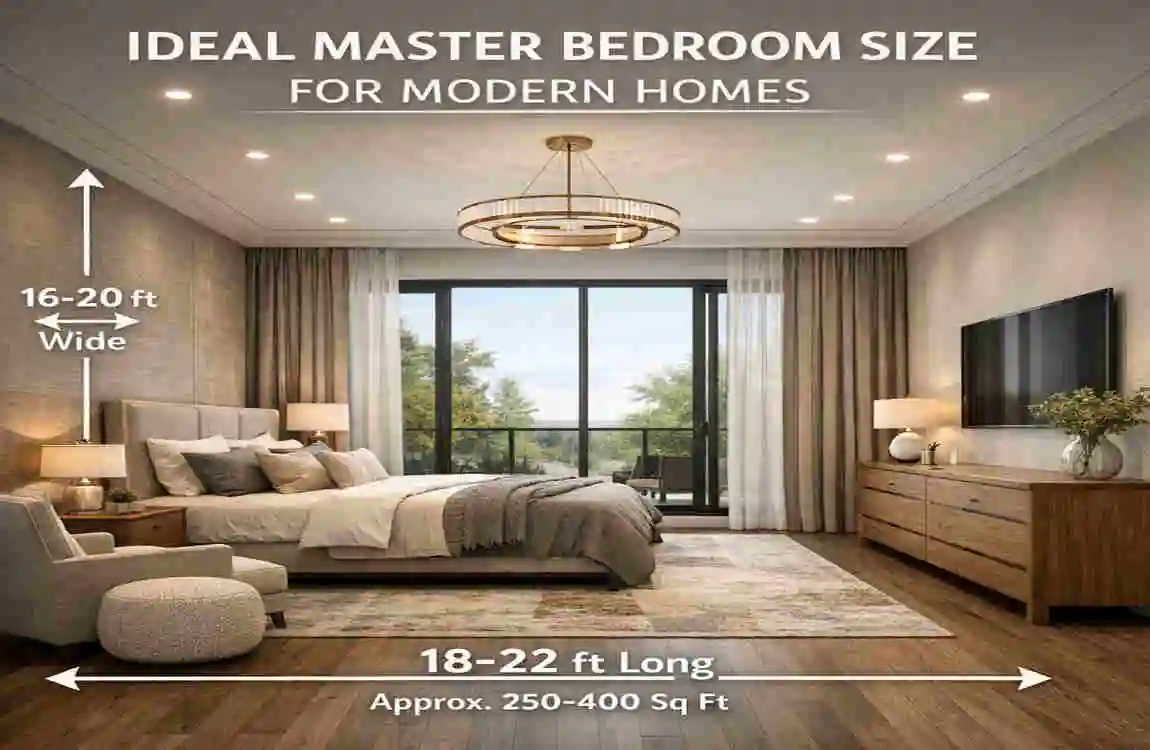
There is no single magic number, but there are definitely golden rules. The ideal dimensions balance absolute comfort, everyday functionality, and modern design trends. Depending on your house layout and your specific lifestyle needs, this space usually ranges anywhere from 200 to 400 square feet.
| Size Category | Dimensions (ft) | Square Footage | Fits In House Size | Key Features |
|---|---|---|---|---|
| Minimum/Small | 12×14 to 14×16 | 168-224 sq ft | Up to 2,000 sq ft | Queen/king bed, nightstands; basic closet |
| Average/Standard | 14×16 to 16×20 | 224-320 sq ft | 2,000-3,000 sq ft | King bed, dresser, seating area; en-suite possible |
| Large/Luxury | 18×20 to 20×22+ | 360-440+ sq ft | 3,000+ sq ft | Walk-in closet, sitting nook, desk; high ceilings |
Standard Dimensions: Finding Your Baseline

When figuring out what a good size for a main bedroom is, it helps to start with the standard measurements used by builders and architects. Understanding these baselines will give you a solid foundation for determining what will work best for your specific house.
The Bare Minimum vs. The Practical Minimum
Technically speaking, international building codes state that a room can legally be called a bedroom if it measures at least 70 square feet and has one dimension of at least 7 feet. However, let us be completely honest with each other: 70 square feet is the size of a large walk-in closet! You cannot comfortably fit a couple, a large bed, and a wardrobe in a space that small.
For a true primary suite, the practical minimum is usually 12 by 14 feet, giving you about 168 square feet. This size comfortably accommodates a queen-size bed, two small nightstands, and a standard dresser. However, it leaves little extra room for a seating area or a massive walk-in closet.
The Average and Ideal Sweet Spot
In most standard modern homes, the average size for a primary bedroom is 14 by 16 feet, totaling 224 square feet. This is widely considered the sweet spot for the average homeowner.
Why is this size so popular? Because it gives you options. In a 224-square-foot room, you can easily upgrade to a luxurious king-size bed. You have plenty of space for wide nightstands, a large dresser, and even a cozy reading chair tucked into the corner. You can walk around the bed without bumping your shins, and the room feels airy and open.
The Luxury Suite
If you are building a custom home or moving into a high-end property, you will likely see dimensions closer to 20 by 20 feet, offering a sprawling 400 square feet of pure living space. This size elevates the room from a simple sleeping area into a true private apartment.
Compared to Guest Rooms
To give you a sense of scale, think about a standard guest room or a child’s bedroom. These secondary rooms usually measure around 10 by 10 feet or 10 by 12 feet (100 to 120 square feet). They are designed primarily to hold a twin or full bed and a small dresser. Your primary suite should feel noticeably larger and more expansive than these secondary rooms to truly serve as the “master” space of the house.
Modern Home Trends Shaping Our Bedrooms
The way we use our homes has changed dramatically over the last few years. The lingering effects of the post-pandemic world, combined with brilliant new architectural ideas, have completely transformed what buyers expect from a primary suite in 2026. Let us look at the modern trends shaping bedroom sizes today.
The Rise of the Open-Concept Suite
We used to think of the bedroom, the bathroom, and the closet as three completely separate boxes with doors. Today, the trend is moving toward open-concept suites. Homeowners want a seamless, fluid transition from the sleeping area into a spa-like en-suite bathroom, followed by a sprawling walk-in closet.
To achieve this flowing design, you need a larger footprint. You need space to transition between wet areas (like a freestanding soaking tub) and dry areas (like your dressing space). This trend pushes the ideal size closer to 300 square feet to accommodate the beautiful, barrier-free flow.
Urban Minimalism vs. Suburban Spaciousness
Where you live heavily dictates the trends you will follow. In dense urban environments where every square inch is incredibly expensive, the trend leans heavily into minimalist efficiency. Urban homeowners are choosing slightly smaller rooms (around 180 square feet) but packing them with brilliant, custom-built storage solutions to keep the floor completely clear.
In contrast, suburban houses are embracing spaciousness. With more land available, suburban builds in 2026 are dedicating massive amounts of square footage to the primary suite, treating it as a distinct wing of the house.
Multifunctional Spaces: More Than Just Sleep
The biggest trend defining what a good-sized main bedroom is right now is multifunctionality. Your bedroom is no longer just for sleeping.
With so many people continuing to embrace remote work, many homeowners are carving out space for a quiet, sunlit home office desk in the corner of their suite. Others are dedicating space to wellness. Imagine having enough floor space to roll out your yoga mat every morning, or keeping a stationary bike near the window. To comfortably fit a sleeping zone, a working zone, and a wellness zone, you naturally need a larger room.
Factors Influencing Your Ideal Room Size
Before you knock down a wall or finalize your new house blueprints, you have to realize that the “perfect” size is highly subjective. What works perfectly for your neighbor might be a complete disaster for you. Let us break down the specific variables that should influence your decision.
Your Family Size and Lifestyle
Do you have a household full of energetic toddlers or pets? If your kids love to pile into your bed on a Saturday morning to watch cartoons, or if you share your sleeping space with two large dogs, you absolutely need a larger bed (like a California King) and more floor space. A 168-square-foot room will feel incredibly crowded when a whole family is gathered inside.
On the other hand, if you are an empty nester or a single professional who only uses the room to sleep, a cozy, smaller room might be exactly what you need to feel secure and relaxed.
Lot Constraints and Architectural Budget
We all want a massive, luxurious retreat, but reality often has other plans. The size of your lot and your overall construction budget will heavily dictate the dimensions of your room. Adding square footage to a house is expensive. You have to pay for more foundation, roofing, drywall, and flooring. Sometimes, keeping the bedroom slightly smaller allows you to allocate your budget toward high-end finishes, such as luxury hardwood floors or a custom shower, rather than wasted floor space.
Regional Norms and Climate Impacts
Believe it or not, the climate you live in should impact your room size! In hot, humid climates, homes naturally benefit from larger rooms with higher ceilings. The extra space allows hot air to rise and allows ceiling fans to circulate cool air more effectively. In contrast, if you live in a region with freezing, bitter winters, a slightly smaller room with lower ceilings is much faster, easier, and cheaper to heat.
Here is a quick breakdown to help you visualize the pros and cons of different sizes:
FactorSmall Bedroom (under 200 sq ft), Ideal Bedroom (200-350 sq ft), Large Bedroom (over 350 sq ft)
Cost to Build & Heat: Very low and budget-friendly—perfectly balanced efficiency—high initial cost and maintenance.
Overall Comfort Cozy, secure, and very easy to clean. Ample room for good furniture flow. Highly luxurious, but can feel echo-prone
Resale Value Appeals to budget/starter home buyers Broad appeal to the majority of the market Appeals exclusively to high-end luxury buyers
The Ultimate Furniture Fit Guide
One of the best ways to figure out what’s a good size main bedroom for you is to work backward. Think about the furniture you absolutely must have, and then build the room around those pieces. Let us detail exactly how to make your furniture fit without making the room feel like an obstacle course.
Sizing Up Your Bed
The bed is the undeniable star of the show. It dictates everything else in the room.
- A Standard Queen Bed: Measures roughly 5 feet wide by 6.5 feet long. It fits beautifully in rooms as small as 120 to 150 square feet.
- A Standard King Bed: Measures roughly 6.3 feet wide by 6.6 feet long. To fit comfortably, you really need at least 180 square feet.
- A California King: Measures 6 feet wide by 7 feet long. This requires a longer room to prevent the foot of the bed from choking the walking path.
Establishing Proper Traffic Flow
This is the absolute most important rule of bedroom design: You must maintain a minimum of 36 inches (3 feet) of clear walking space around the sides and foot of your bed.
Why 36 inches? Because that is the standard width required for a person to walk comfortably without having to turn sideways. It gives you enough room to open dresser drawers without hitting the bed frame. It also allows two people to pass each other in the dark without bumping shoulders. If you squeeze a massive king bed into a tiny room and only leave 18 inches of walking space, your daily routine will feel incredibly frustrating and cramped.
Accommodating Dressers and Vanities
Once your bed is in place, consider your storage. A standard long dresser is usually 18 to 22 inches deep and about 5 feet long. You need to account for the depth of the dresser, the 36-inch walking path, and the space required to actually pull the drawers open.
If you dream of a dedicated makeup vanity, factor in the desk depth and the space for the chair to pull out. When sketching out your room, always draw the furniture with its doors and drawers fully open to see the true footprint!
Luxury vs. Compact Options: Adapting to Your Home
Whether you live in a sprawling estate or a cozy bungalow, you can create a beautiful primary suite. The approach changes based on the square footage you have available.
Designing High-End Luxury Retreats
If you have the luxury of space—meaning you are working with 400 to 500+ square feet—the challenge is actually making the room feel warm and intimate. A massive, empty square box can feel like a high school gymnasium.
To master a luxury space, you need to create “zones.” Use area rugs to define a dedicated sleeping zone. On the other side of the room, arrange two plush armchairs and a small coffee table to create a cozy reading or conversation zone. You might even use a freestanding, double-sided fireplace in the middle of the room to separate the sleeping area from a private morning coffee station. Luxury is all about layering these different experiences within one massive room.
Maximizing Compact Starter Homes
If you are living in an older home or a starter house where the primary bedroom barely scrapes 150 square feet, do not panic! You can make a small room feel incredibly grand by utilizing a few designer tricks.
First, look up. Vertical storage is your best friend. Instead of a wide, low dresser that eats up precious floor space, opt for a tall, narrow chest of drawers.
Second, embrace custom built-ins. Having a carpenter build custom closets and shelves directly into the walls eliminates the need for bulky, freestanding furniture. You can even build your nightstands into the headboard of the bed to save crucial inches on either side. Lastly, use wall-mounted lighting (sconces) instead of table lamps to keep your surfaces clear and visually light.
Calculating Your Exact Needs
Are you ready to figure out the exact math for your own house? Let us walk through a very simple, step-by-step formula to calculate exactly how much space you need to live comfortably. Grab a notepad and a tape measure!
Measure Your Dream Bed
Start with the absolute largest piece of furniture you plan to own. If you want a standard King bed, write down its dimensions (roughly 76 inches wide by 80 inches long).
Add Your Clearance Zones
Next, add your non-negotiable walking paths. Add 36 inches to the left side of the bed, 36 inches to the right side of the bed, and 36 inches to the foot of the bed. This creates the absolute minimum “bubble” your bed requires to function.
Factor in Your Extras
Now, list out your other essential furniture.
- Do you need a large dresser? Add 2 feet for its depth, plus 3 feet of walking space in front of it.
- Do you want a reading chair? Add a 3-foot by 3-foot square to one of the corners.
- Do you want a dog bed on the floor? Add that footprint.
Visualize with Tools
Once you have your rough total, do not just trust the numbers on paper. Bring them to life! We highly recommend using free online room-planning tools that let you drag and drop digital furniture into a virtual floor plan.
If you are already standing in the physical room, use the ultimate designer trick: grab a roll of blue painter’s tape. Tape the exact outline of your bed and your dressers directly onto the floor. Then, physically walk through the pathways. Does it feel tight? Do you have to squeeze past the taped “dresser”? If so, you either need smaller furniture or a bigger room!
Common Mistakes to Avoid During Your Build or Reno
Even the most well-intentioned homeowners can accidentally ruin a great space. When trying to answer what’s a good size main bedroom, many people fall into a few very common, very frustrating traps. Let us make sure you avoid these renovation nightmares.
Undersizing Your Storage for More Floor Space
This is the number one mistake we see. Homeowners get so obsessed with having a massive, empty bedroom floor that they shrink their closets to compensate. Remember this: a giant bedroom is completely useless if it is constantly cluttered with clothes and shoes because your closet is too small. Always sacrifice a little bit of bedroom floor space to ensure you have a highly functional, well-organized walk-in closet.
Ignoring the Power of Natural Light
You can build a 500-square-foot luxury suite, but if it only has one tiny window, it will feel like a depressing cave. Natural light creates the illusion of space. When planning your room dimensions, you must plan your window placement simultaneously. Ensure you have enough wall space to accommodate large, bright windows that will bathe the room in morning sunlight, making even a small room feel brilliantly expansive.
The Pitfalls of Moving Load-Bearing Walls
If you are renovating an existing house and want to expand your bedroom by knocking down a wall, proceed with extreme caution. Never assume a wall is just drywall. It might be a load-bearing wall holding up your roof, or it might be hiding essential plumbing pipes and electrical panels. Moving these elements will absolutely skyrocket your renovation budget. Always have a structural engineer inspect the walls before you start swinging a sledgehammer.
Expert Tips and Examples for the Perfect Space
To give you a little more inspiration, let us look at some insider secrets used by top architects and interior designers in 2026. These professionals know exactly how to manipulate space to create a feeling of ultimate relaxation.
Zoning for the Best Views
Architects do not just place a bed against a random wall; they carefully “zone” the room based on the view. Imagine waking up and looking straight out of a set of sliding glass doors into your lush backyard or a beautiful sunrise. By placing the bed on the opposite wall of your best windows, you make the room feel like it extends all the way out into nature. This visual trick makes a 200-square-foot room feel like it is 1,000 square feet.
Mastering Smart Lighting Solutions
Lighting completely alters how we perceive a room’s size. Experts always recommend layering your lighting. You need bright overhead lights for getting dressed, soft bedside lamps for reading, and subtle, hidden LED strip lighting behind the headboard or under the bed for a relaxing evening glow. Dimming the lights creates deep shadows that blur the edges of the room, making it feel incredibly cozy and boundless.
Case Study in Modern Living
Let us look at a recent fictional example of a modern 2026 home renovation. Sarah and Mark lived in a suburban house with a primary suite measuring 14 by 14 feet (196 square feet). It felt too small for their new work-from-home lifestyle.
Instead of an expensive exterior addition, they smartly annexed a tiny, unused guest bedroom next door. They knocked down the connecting wall, expanding their space to 320 square feet. This new, larger footprint allowed them to create a distinct sleeping zone, add a beautiful built-in window seat for reading, and carve out a small, sunlit nook for a sleek, modern desk. By rethinking their existing square footage, they created a perfectly balanced, multifunctional retreat without changing the outside of their house.
Master Bedroom Size – FAQ
What is a good size for a master bedroom?
A good master bedroom size is typically 12×14 feet (3.6 x 4.2 m) or larger. This allows space for a bed, side tables, and comfortable movement.
What is considered a large master bedroom?
A large master bedroom is usually 14×16 feet (4.2 x 4.8 m) or more, giving extra room for seating areas or a workspace.
What is the minimum size for a master bedroom?
The minimum comfortable size is around 10×12 feet (3 x 3.6 m), but it may feel tight with larger furniture.
How much space do you need around a bed?
You should have at least 2–3 feet (60–90 cm) of walking space around the bed for easy movement.
Does a master bedroom need a bathroom?
Yes, a true master bedroom (or primary bedroom) usually includes an attached bathroom (ensuite) and sometimes a walk-in closet.
Is a 12×12 bedroom big enough for a master?
It can work, but it’s on the smaller side. It’s best suited for a simple layout without extra furniture.
What size bed fits best in a master bedroom?
A queen or king-size bed fits best, depending on room size. King beds need more space for comfort.
How big should a luxury master bedroom be?
Luxury master bedrooms are often 16×20 feet (4.8 x 6 m) or larger, with space for seating, dressing areas, and more.
