

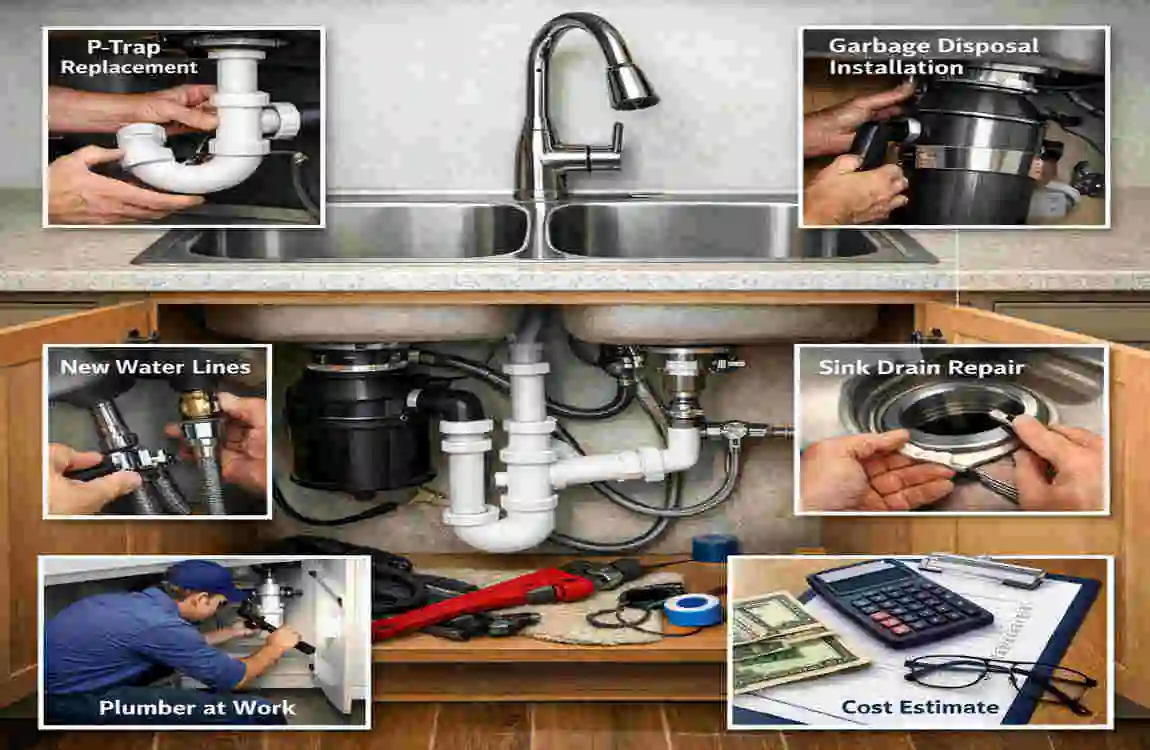
Imagine this all-too-common Florida scenario. It is the middle of a chaotic hurricane season. The wind is howling outside your Miami home, the rain is coming down sideways, and the power has just flickered off. You walk into your kitchen to grab a flashlight from the cabinet under the sink, only to step into a growing puddle of murky water. Your old, corroded pipes have finally given up, and now you have a flooded kitchen amid a raging storm outside.
If you own a house in the Sunshine State, you know that home maintenance comes with its own unique set of tropical challenges. When faced with a plumbing disaster, the very first question that pops into your stressed mind is likely: how much does it cost to replumb a kitchen sink in Florida?
You need numbers, and you need them fast. To give you the direct answer right away: replumbing a kitchen sink in Florida typically costs homeowners anywhere from $650 to $1,500. This price range generally covers professional labor and basic, high-quality PEX or PVC pipes.
However, the year 2026 has brought its own set of economic shifts. Thanks to recent inflation, rising material costs, and a state-wide shortage of skilled trade laborers, these costs are trending slightly higher than they were just a few years ago.
Why Replumb Your Kitchen Sink in Florida?

Florida is a beautiful place to live, but our environment is incredibly harsh on building materials. You might be wondering why your pipes are failing while your family up north has had the same plumbing since the 1980s. The answer lies in the air you breathe and the ground you walk on.
The Unique Dangers of the Sunshine State
Many older homes across Florida were built using galvanized steel pipes. While steel sounds strong, it has a massive weakness: salt and moisture. The salty, coastal air that makes Florida beaches so wonderful is highly corrosive to metal. Furthermore, the intense, year-round humidity means your cold water pipes are constantly “sweating” inside your dark, unventilated cabinets. This constant moisture accelerates wear and tear and promotes aggressive rust.
Additionally, we cannot ignore the impact of our severe weather. Post-storm leaks are incredibly common. When massive hurricanes blow through, the sheer force of the wind and subtle ground shifting can put immense pressure on your home’s foundation, causing old, rigid pipes to snap or loosen at joints. Florida building codes are constantly updating to address these issues, often requiring flexible PEX piping in certain zones because it can bend and flex during extreme weather without breaking.
Warning Signs You Cannot Ignore
How do you know it is time to stop patching and start replacing? Your sink will give you several clear warning signs:
- Low Water Pressure: If your faucet used to blast water but now only offers a sad trickle, your older metal pipes are likely corroding from the inside out, restricting the water flow.
- Persistent Rust Stains: If you see reddish-brown stains in your sink basin, or if your water briefly runs brown when you first turn it on, your pipes are rusting internally.
- Constant, Unfixable Drips: If you have tightened every bolt and replaced the faucet cartridge, but a puddle still forms under your sink every week, the pipe connections have fundamentally failed.
- Musty Odors: A smell of mildew under the sink means water has been slowly leaking into the wood for a long time.
The Kitchen Sink vs. The Whole House
When considering the cost of replumbing your Florida kitchen sink, it is helpful to look at the bigger picture. Statistics from 2026 real estate surveys show that roughly 40% of Florida homes over 30 years old are in desperate need of plumbing updates.
If you only need to fix the kitchen sink, you are looking at $650 to $1,500. However, if your entire house has failing galvanized pipes, you might need a full house repipe. A full residential repipe in Florida can cost anywhere from $1,500 for a tiny one-bathroom home up to $15,000 for a sprawling, multi-story estate. Upgrading your kitchen sink now is a smart, localized investment that stops the most heavily used plumbing in your house from failing first.
Average Costs to Replumb a Kitchen Sink in Florida
Let us break down the exact numbers. When you ask a contractor, “How much does it cost to replumb a kitchen sink in Florida?” they do not just pull a number out of thin air. Your final bill is a carefully calculated combination of labor, parts, regional demand, and administrative fees.
As a house owner, understanding these line items gives you incredible power when reviewing quotes and negotiating prices.
The Heavy Hitter: Labor Costs
In 2026, labor is undeniably the most expensive part of any home repair. You are not just paying for a person to turn a wrench; you are paying for their licensing, insurance, gas, and specialized expertise.
For a standard kitchen sink replumb, you can expect the plumber to be working in your home for 2 to 4 hours. Current Florida labor rates range from $75 to $200 per hour, depending on the plumber’s level of experience. Therefore, the labor portion of your bill alone will typically range from $230 to $650.
Keep in mind that where you live dictates the hourly rate. If you live in a booming metropolitan area like Orlando or Tampa, the massive demand for contractors drives labor prices toward the higher end of that scale. Plumbers have more work than they can handle, so their time becomes much more expensive.
Breaking Down the Materials
The actual physical pieces of plastic and metal are usually the cheaper part of the project. Here is what you are paying for regarding materials:
- The Pipes (PEX or PVC): Modern plastic piping is highly affordable. The necessary lengths of PEX or PVC to connect your sink to the main lines in the wall will usually cost between $100 and $300.
- Fittings and Shutoff Valves: Every pipe needs elbows, connectors, and safety valves. Replacing the hot and cold shutoff valves under your sink is highly recommended during a replumb, and these brass or plastic fittings will add $50 to $150 to your total.
- Garbage Disposal Lines: If your sink features a garbage disposal and a dishwasher connection, the plumber must run additional, specialized drain lines. This added complexity usually adds $200 in materials and specific fittings.
Cost Summary Table for Florida Houses
To make these numbers easy to digest, we have created a quick reference table. This outlines the average cost ranges you will see in 2026, along with specific notes for Florida homeowners.
Cost Factor Average Range (2026)Florida House Notes
Basic Replumb (pipes only): $650-$1,000. Assumes easy cabinet access. PVC or PEX is the standard material used to combat coastal humidity.
Full Replumb (sink + faucet + disposal) $1,000 – $1,500 Removing and reinstalling heavy undermount sinks adds roughly $200 to the labor total.
Emergency / After-Hours Call +30% to 50% ($900 – $2,000). Prices surge massively during hurricane season or holiday weekends when plumbers are scarce.
Local Permits & Inspections $50 – $150 South Florida (e.g., Miami-Dade County) has notoriously strict building codes that require thorough inspections.
The Regional Variances: North vs. Central vs. South Florida
Florida is a massive state, and Miami’s economy is entirely different from Tallahassee’s.
If you are calculating your budget for replacing the plumbing in your house sink in Florida, you must factor in your zip code. Data shows that plumbing jobs in South Florida (Miami, Fort Lauderdale, West Palm Beach) are routinely 20% higher than identical jobs in Central Florida (Orlando, Lakeland). This price hike is driven by higher general cost of living, worsening traffic (which limits how many jobs a plumber can do in a day), and the exceptionally strict building codes implemented in South Florida following the devastation of historic storms like Hurricane Andrew.
Factors Affecting Kitchen Sink Replumbing Costs in Florida Houses
So, the average is between $650 and $1,500. But what pushes your specific bill to the high end or the low end of that spectrum? Every kitchen is unique. The specific choices you make—and the layout of your home—will drastically alter your final invoice.
Let us explore the hidden factors that affect your bottom line.
The Type of Sink You Choose
If your replumb includes replacing the actual sink basin, the style you choose matters immensely.
- Drop-in Sinks: These are the most common and the cheapest to work with. They drop into a pre-cut hole in your countertop, and the edges rest on the countertop. Plumbers can easily reach underneath them, keeping your total project cost closer to $800.
- Farmhouse Sinks: These massive, deep, apron-front sinks are incredibly popular in modern kitchen designs in 2026. However, they are incredibly heavy and require custom cabinet supports. Replumbing a brand-new farmhouse sink can easily push your bill to $1,200 or more because of the intense, precise labor required to fit the pipes around the bulky basin.
Location and Accessibility (The Island Sink Trap)
Where your sink is located in the kitchen is a massive cost factor. If your sink is located against an exterior or interior wall, the plumber has easy access to the main water lines hiding behind the drywall.
However, if you have an island sink sitting right in the middle of your kitchen floor, prepare your wallet. In Florida, most homes are built on solid concrete slab foundations. To run pipes to a kitchen island, the plumbing has to go down into the concrete slab. If the drain pipe in your island is failing, the plumber might have to use a jackhammer to break up your tile floor and the concrete foundation to reach the pipes. This nightmare scenario can easily add $300 to $800 to your bill.
Pipe Material Choices (PEX vs. Copper)
The physical material you choose changes everything.
- PEX (Cross-linked Polyethylene): This flexible, durable plastic tubing is the superhero of modern Florida plumbing. It doesn’t rust, it can bend around corners without extra glued joints, and it expands rather than cracking when the house shifts. Best of all, it only costs about $1 per linear foot.
- Copper: a classic, beautiful, and highly durable metal. Some homeowners insist on it. However, it requires a plumber to use a dangerous blowtorch to solder joints together. It is incredibly time-consuming and costs roughly $5 per linear foot. Demanding copper will skyrocket your costs.
The Age and Climate Wear of Your Home
If you live in a classic 1960s Florida ranch-style home, you have to be prepared for domino-effect repairs.
When a plumber crawls under your sink to replace a pipe, they have to turn off the water using the small shutoff valves on the wall. In a 60-year-old Florida house, those metal valves have been sitting in salty, humid air for decades. The second the plumber tries to turn the rusty handle, it will likely snap off in their hand. What was supposed to be a simple pipe swap now requires shutting off the water to the entire house, cutting into the wall, and soldering on brand-new shutoff valves.
Quick Checklist for Florida Owners: Before the plumber arrives, check your valves. Are they covered in green or brown crust? If so, tell the plumber on the phone that you will likely need new shutoff valves. Preparing them in advance saves them a trip back to the hardware store, which saves you an hour of labor costs!
DIY vs. Professional Replumbing: Florida House Owner Tips
When you see a quote for $1,200, it is incredibly tempting to drive down to the local big-box hardware store, buy a cart full of PVC pipes, and watch a few online video tutorials. You might think, “How hard can it really be?”
Deciding whether to tackle a house sink plumbing replacement project in Florida yourself or hire a professional requires a brutally honest assessment of your skills. Let us compare the two routes.
The Allure of DIY Savings
The biggest benefit of doing it yourself is the money you save. If you cut out professional labor entirely, you could save 40% to 60% of the total project cost.
If you are only buying materials, you can expect to spend between $300 and $800, depending on the fixtures you choose. To do the job right, you will need specific tools: a high-quality pipe cutter, PVC primer and cement, an adjustable wrench, a bucket, and modern push-to-connect fittings (often called SharkBites), which make joining pipes much easier for beginners.
Step-by-Step for Simple Jobs: If you are only replacing the plastic P-trap (the curved drain pipe under the sink) because it is leaking, DIY is a great choice. You place a bucket underneath, unscrew the plastic nuts by hand, remove the gross old pipe, and hand-tighten the new plastic pipe into place. It takes 20 minutes and costs $15.
The Heavy Case for Hiring a Professional
However, if you are messing with the pressurized water supply lines, moving drains, or dealing with anything inside the walls, you desperately need a professional. Here is why:
- Code Compliance and Florida Statutes: The state of Florida takes building codes very seriously. Under Florida Statute 489, unlicensed contracting is heavily penalized. If you do major plumbing work without a permit or a license, and it is not up to the strict hurricane and building codes, you will face massive headaches when you try to sell your house. A home inspector will flag the amateur work, and you will have to pay a professional to rip it out and do it again anyway.
- Voiding Your Warranties: Did you buy a beautiful, expensive $400 touchless kitchen faucet? If you read the fine print in the box, you will see that installing it yourself often voids the manufacturer’s warranty. They require proof of professional installation to cover any future defects.
- The Risk of Catastrophe: Water is the most destructive force you can let loose inside a house. If you fail to crimp a PEX pipe correctly, it might hold for three days. But on the fourth day, while you are at work, it will blow off the wall. You will come home to a flooded kitchen, ruined baseboards, and destroyed laminate flooring. Worse yet, if your homeowner’s insurance discovers the flood was caused by unlicensed, amateur plumbing work, they will likely deny your claim entirely.
For anything beyond a simple drain swap, hiring a licensed, bonded, and insured Florida plumber is not an expense; it is an insurance policy for your peace of mind.
Top Florida Plumbing Cost-Saving Strategies for House Owners
Just because you are hiring a professional does not mean you have to pay the absolute maximum price. Savvy Florida homeowners know how to work the system to get the best possible deal.
If you want to keep your Florida kitchen sink replumb cost as low as possible, employ these highly effective strategies.
Always Get Three Quotes (and Time It Right)
Never, ever accept the very first estimate you receive. The plumbing industry is highly competitive. Call three well-reviewed local companies and ask for written estimates. You will often find a difference of hundreds of dollars between them. Use the lowest reasonable quote as leverage to negotiate with the company you actually want to hire.
Furthermore, timing is everything. Do not schedule non-emergency plumbing work in the direct aftermath of a hurricane or major tropical storm. Every plumber in the state will be booked solid, fixing catastrophic floods, and they will charge Premium surge pricing. Wait for the off-season (typically our mild winter and spring months) when plumbers are hungry for indoor work and more willing to offer discounts.
Bundle Your Upgrades
Plumbers charge a “trip fee” just to drive their truck to your driveway. If they are already under your kitchen sink, that is the cheapest time to do other upgrades.
Do not pay a plumber to fix a pipe today, and then pay another trip fee six months from now to install a new faucet. Bundle everything together. If you are replumbing, buy the new garbage disposal, the high-end faucet, or the under-sink water filtration system you have been wanting, and have the plumber install them all at once. The bundled labor rate will save you hundreds.
Check Your Homeowner’s Insurance
Did your kitchen sink pipes burst due to a covered peril? For example, if a severe storm caused a tree branch to hit your roof, compromising the house structure and snapping a plumbing line in the wall, your homeowner’s insurance might cover it.
While standard wear-and-tear is never covered, sudden and accidental water damage often is. If you file a successful storm damage claim, your insurance could cover 50% to 80% of the replumbing and water mitigation costs. Always call your agent before you start tearing out cabinets.
Practice Preventive Maintenance
The best way to save money on plumbing is to avoid needing a plumber in the first place. Extend the life of your new pipes by ten years or more with basic maintenance. Stop pouring harsh, heat-generating chemical drain cleaners (like Drano) down your sink, as they can melt plastic pipes and corrode metal. Do not pour hot bacon grease down the drain, where it will solidify into a rock-hard blockage in your Florida slab. Clean your faucet aerators regularly to maintain optimal water pressure.
Cost Trends and ROI for Florida Kitchen Replumbs

As we navigate through 2026, it is important to understand the broader economic trends shaping the home improvement industry in Florida.
Currently, general home repair inflation has driven costs up roughly 10% compared to 2025. This is largely due to rising fuel costs (affecting supply chains) and a continuing shortage of young people entering the plumbing trades.
However, there is a silver lining for house owners. The widespread, near-universal adoption of PEX piping across Florida has actually helped offset these rising labor costs. Because PEX is much faster to install than traditional copper or rigid PVC, plumbers can finish the job more quickly, which cuts your hourly labor bill by roughly 15% compared to the old days of metal soldering.
The Return on Investment (ROI)
Do not look at a plumbing bill as money thrown into a hole. Look at it as a vital investment in your property value.
In the highly competitive 2026 Florida real estate market, buyers are terrified of buying a house with hidden water damage. If you can show potential buyers a recent receipt proving that the kitchen plumbing has been completely modernized with high-quality materials, you instantly boost buyer confidence.
Real estate data shows that fully updating a kitchen’s plumbing and fixtures can boost your overall home value by up to 5%. In a market where average homes cost well over $400,000, that translates to a massive return on investment when it comes time to sell. A $1,500 replumb today could easily translate into an extra $10,000 in your pocket at the closing table, making it one of the smartest upgrades a Florida homeowner can make.
FAQs
Even with a detailed guide, plumbing can be incredibly confusing. Here are the direct answers to the most frequently asked questions regarding Florida kitchen plumbing projects.
How much does it cost to replumb a kitchen sink in Florida? On average, in 2026, Florida homeowners pay between $650 and $1,500 to have a kitchen sink professionally replumbed. This price covers both the physical materials and the plumber’s hourly labor. Basic pipe swaps land on the lower end, while jobs requiring new sinks, wall access, or island sink trenching hit the higher end.
Is PEX or PVC better for Florida houses? PEX (cross-linked polyethylene) is generally considered superior for indoor water supply lines in Florida. It is highly flexible, meaning it will not snap if your house settles or shifts during severe weather. It is also completely immune to the rust and corrosion caused by Florida’s humid, salty air. PVC is still excellent and strictly required for the non-pressurized drain lines.
Does homeowners’ insurance cover a sink replumb? Usually, no. Standard homeowners’ insurance policies do not cover damage caused by routine wear and tear, aging, or slow-maintenance leaks. However, if your pipes were suddenly damaged by a covered event—such as a falling tree during a hurricane—the resulting plumbing repairs and water damage cleanup would likely be covered.
How long does a kitchen sink replumb actually take? If you hire a licensed professional, a standard kitchen sink replumbing job usually takes 2 to 4 hours from start to finish. If the plumber has to cut into the drywall to replace old shutoff valves or reroute main lines, the job can stretch to 6 or 8 hours.
Do I need to pull a permit to fix my sink pipes in Florida? It depends on the scope of the work. If a plumber is swapping out a broken P-trap or replacing an identical faucet, a permit is usually not required. However, if you are moving the plumbing, ripping out walls, or doing a full kitchen remodel, stringent Florida building codes (especially in Miami-Dade and Broward counties) will absolutely require a permit and a final inspection.
What exactly is involved in a house sink plumbing replacement in Florida? The process begins with shutting off the main water supply. The plumber will then dismantle and remove the old, corroded drain and supply pipes. They will install brand-new hot- and cold-shutoff valves on the wall, run flexible PEX supply lines to the faucet, build a new PVC drain trap, securely connect the dishwasher and garbage disposal, and finally test the entire system under high pressure to ensure there are no leaks.
