

Did you know that more than 13 million households across the United States rely entirely on private wells for their daily drinking water? That is a staggering number of families who depend on the ground beneath their feet for safe, clean, and reliable hydration. But if you are building a new home, buying rural land, or an old, failing water system, you are probably asking one incredibly important question: how deep should a residential well be?
It is a simple question with a surprisingly complex answer. Getting your residential well depth right is not just a matter of guesswork; it is the absolute foundation of your home’s sustainability, health, and safety. If you drill a well that is too shallow, you risk running dry during the hot summer months or, worse, drawing in dangerous surface contaminants like pesticides and bacteria. On the other hand, if you drill deeper than necessary, you are throwing thousands of hard-earned dollars down a literal hole in the ground.
Average Residential Well Depths: What to Expect
When homeowners first start looking into private water systems, they usually want a quick, standard number. So, exactly how deep should a residential well be on average?
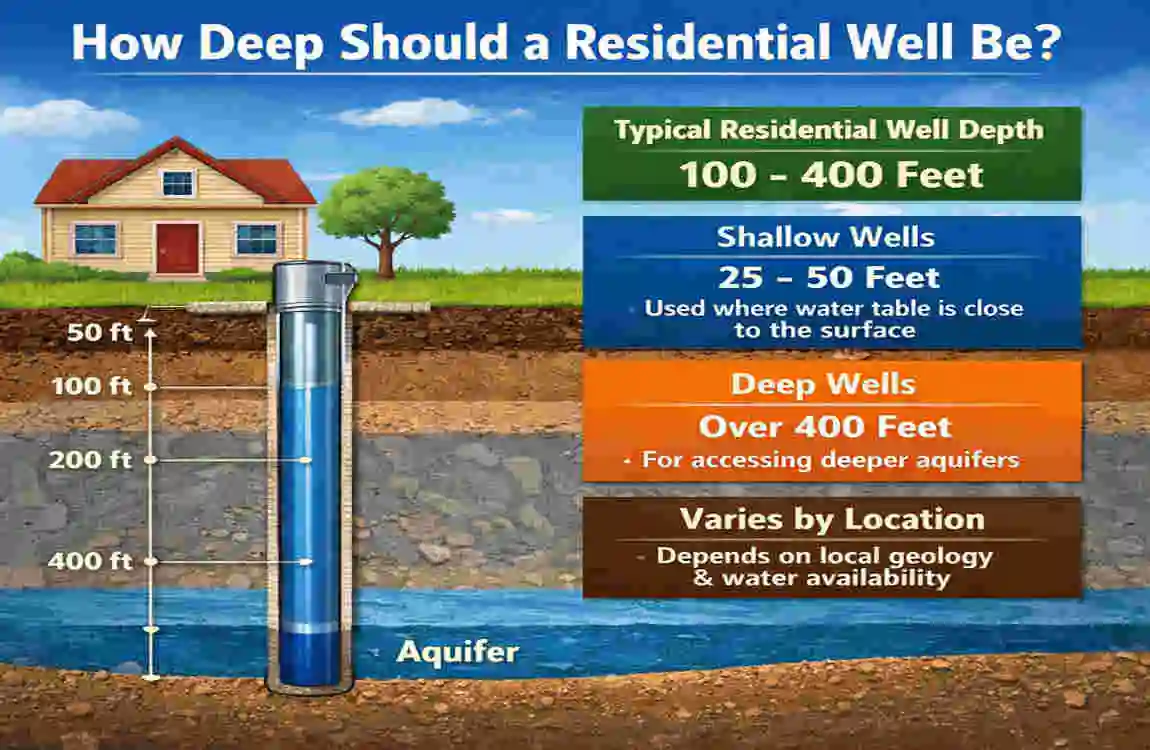
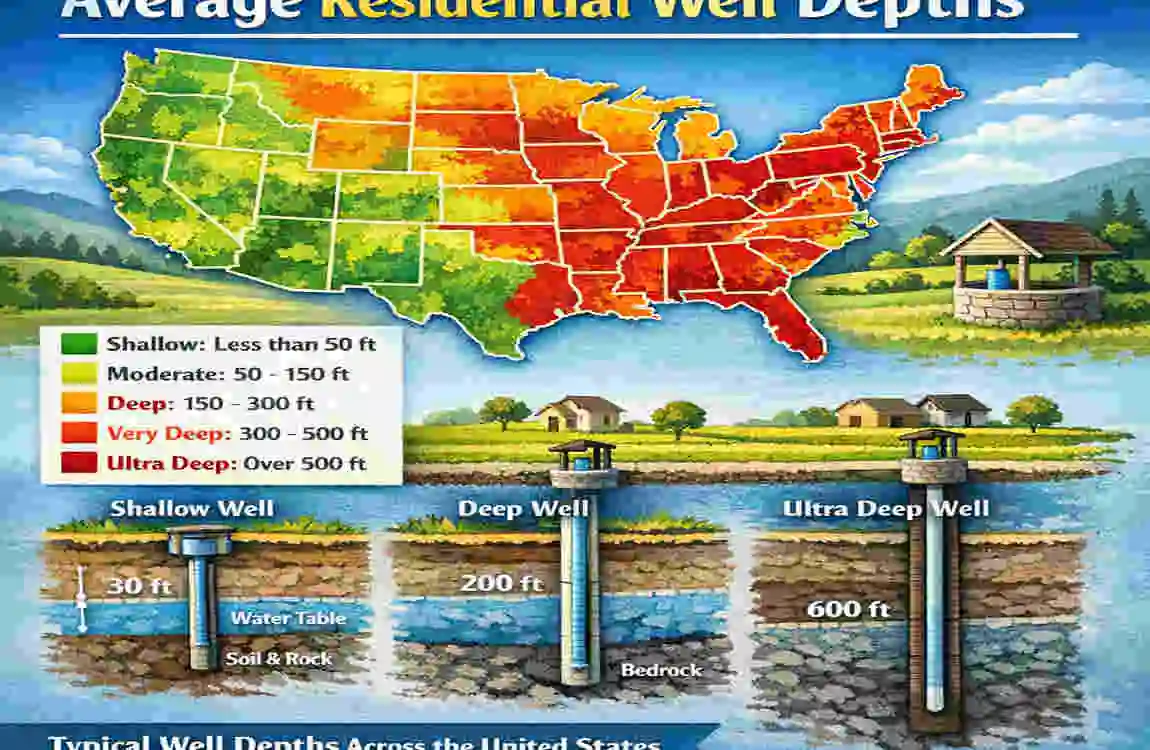
Most residential wells range from 100 to 400 feet deep, depending heavily on local geology and the level of the underground water table. To ensure reliable access to clean groundwater, a vast majority of luxury homes in the U.S. find their sweet spot falling right between 150 and 300 feet, according to drilling professionals at .
However, we can break these average depths down into three distinct categories to help you understand what might work best for your property.
Shallow Wells (25 to 100 Feet)
Shallow wells are exactly what they sound like. These wells rarely exceed 100 feet in depth and are typically dug or bored rather than drilled with heavy machinery. They are generally only suitable for areas that boast exceptionally high water tables and very porous, sandy soils.
While they are highly affordable to install, shallow wells come with significant risks. Because the water is so close to the surface, it is highly susceptible to contamination from surface runoff. Fertilizers, animal waste, septic tank leaks, and road salts can easily seep into shallow aquifers. Experts at often caution against shallow wells for primary drinking water unless rigorous, ongoing water testing and filtration systems are in place.
Medium Wells (100 to 300 Feet)
For the vast majority of Americans, the ideal well depth for homeowners falls into the medium category. Ranging from 100 to 300 feet, this depth provides the perfect balance between cost and water security.
At this depth, the water is usually protected by multiple layers of dense soil, clay, and rock, which act as a natural, massive filtration system. This drastically reduces the risks associated with surface runoff and bacterial contamination. As noted by., a medium-depth well provides a highly reliable yield that can easily sustain a modern family’s daily water use without breaking the bank during drilling.
Deep Wells (400+ Feet)
Sometimes, you have to keep drilling. Deep wells, plunging 400 feet or more into the earth, are often required in arid climates, mountainous regions, or areas with thick, solid bedrock such as granite.
In these regions, the water table is incredibly low, and drillers must push deep into the earth to find stable, water-producing fractures in the rock. While this deep groundwater is usually exceptionally clean and isolated from surface pollution, the drilling process is expensive and time-consuming. According to , deep wells are essential in drought-prone areas where shallower aquifers dry up quickly.
Quick Comparison: Well Depth Categories
To make things easier to digest, here is a quick breakdown of the pros, cons, and best-use cases for each well depth category:
Well Type Depth Range Pros Cons Best For
Shallow 25-100 ft Low installation cost, easy access High contamination risk, unreliable in summer Wet climates with pristine surroundings, per
Medium 100-300 ft Reliable yield, clean water, moderate cost Requires specialized drilling equipment Most U.S. homes and average topographies, per .
Deep 400+ ft Very clean water, highly drought-resistant High installation and pump costs Drought-prone or rocky areas, per
Key Factors Influencing Your Specific Well Depth
Now that we know the national averages, you might be asking: “So, how deep should a residential well be on my specific property?”
The truth is, residential well depth varies wildly based on local geology. There is absolutely no one-size-fits-all answer in the well-drilling business, a fact heavily emphasized by You could drill a fantastic well at 150 feet, while your neighbor half a mile down the road might have to drill down to 350 feet to get the same water pressure.
Let’s explore the massive underground variables that dictate your final depth.
Geology and Aquifer Depth
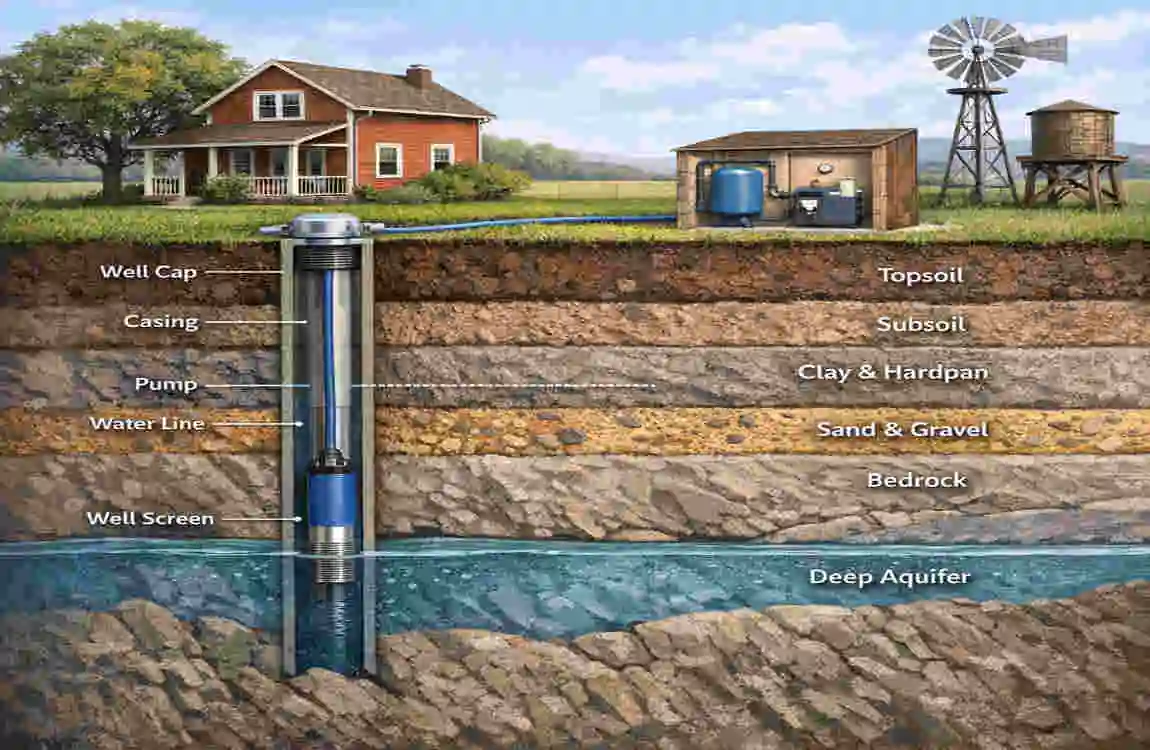
Think of an aquifer not as an underground lake, but as a giant, subterranean sponge made of rock, gravel, and sand. The type of rock beneath your stunning home dictates how much water it stores and how quickly it can flow into your well pipe.
Sedimentary rocks, like sandstone and limestone, are porous and hold a lot of water. If you live over sedimentary rock, you might not need to drill very deep. However, if your property sits on igneous rock like solid granite, water only exists in tiny cracks and fractures. Drillers have to keep going deeper and deeper to intersect enough of these tiny fractures to supply a home.
Furthermore, standard industry practice dictates that you should always aim to drill at least 10 to 20 feet below the water table. This ensures your pump remains fully submerged even if water levels fluctuate, a standard recommended by .
Water Table and Seasonal Changes
Your local water table—the upper surface of the underground zone heavily saturated with water—is not a static, unmoving line. It breathes, rising and falling with the seasons.
During the wet spring months, the water table rises. During the hot, dry days of August, it drops. If you live in an area prone to severe, multi-year droughts, the water table can plummet drastically. If your well isn’t deep enough to account for these seasonal and climate-driven changes, you will turn on your faucet one summer morning and get absolutely nothing. As noted by , anticipating these historical lows is a massive factor in determining your final depth.
Location-Specific Examples
Geography plays a starring role in the “how deep” equation. Let’s look at a couple of vastly different environments to illustrate this point:
- Virginia and the East Coast: In places like Virginia, the soil is often rich, and the climate receives consistent rainfall. Here, a medium well is usually perfect. The team at. notes that residential wells in these areas frequently fall right into the 50 to 200 feet range.
- California and the West Coast: California presents a totally different challenge. Between historic droughts and solid granite mountain ranges, the water table is much lower and harder to access. Homeowners here regularly see residential well depths of 250 to 600 feet to reach a stable aquifer, according to
Additional Influencing Factors
Beyond rocks and rain, several other localized factors will alter your ideal depth:
- Topography: If your house is perched on top of a massive hill, you automatically have to drill deeper through the dry dirt to reach the baseline water table that homes in the valley are sitting right on top of.
- Neighboring Wells: If you live in a dense subdivision where everyone has their own well pulling from the same aquifer, the collective drawdown can lower the water table for everyone, requiring you to drill slightly deeper to stay competitive.
- Local Regulations: Government standards often dictate minimum depths to prevent contamination, which we will cover later in this guide. reminds homeowners to always verify local codes before breaking ground.
How to Determine Your Ideal Well Depth
You do not have to cross your fingers and start digging. There is a precise, scientific process used to figure out exactly how deep a residential well should be before the heavy machinery ever rolls onto your lawn.
If you want to find the ideal well depth for homeowners in your specific neighborhood, follow this proven step-by-step process.
Research Local Water Table Data
Your first line of defense is public data. You can research your local water table by reviewing historical groundwater surveys from the United States Geological Survey (USGS) or your state’s Department of Natural Resources. These databases offer free, accessible maps that show average aquifer depths and historical drought impacts in your exact county.
Hire a Professional Hydrogeologist
While data is great, nothing beats boots on the ground. Hiring a licensed hydrogeologist for a site assessment is one of the smartest investments you can make. They will evaluate your property’s specific topography, soil composition, and underlying rock formations. As . points out, a professional assessment removes the guesswork and gives you a highly accurate estimate before drilling starts.
Review Neighboring Well Logs
In the well-drilling industry, your neighbors are your best resource. Every time a legal well is drilled, the contractor files a “well log” (or well record) with the state or county. These logs are public record. By pulling the logs of the homes adjacent to your property, you can see exactly how deep they had to drill, what rock they hit, and where they found water. highly recommends using neighbor logs as your primary benchmark for expectations.
Perform a Yield Test
Depth means nothing if the water doesn’t flow fast enough to meet your needs. As the drillers hit water, they will perform a “yield test” to measure how many gallons per minute (GPM) the well can produce. For a standard modern household to run showers, dishwashers, and washing machines simultaneously, you need a minimum yield of 5 GPM, according to experts at. If you hit water at 150 feet but it only yields 2 GPM, the drillers will have to keep going deeper to find a higher-producing fracture.
Your Well Depth Action Checklist
Action Item: Why It Matters, Who to Contact
Check USGS Maps for a regional overview of the water table. USGS Website / Local Gov
Pull Neighbor Logs provides literal proof of nearby aquifer depths. County Health Department
Consult a Hydrogeologist. Customizes data to your specific property lines. Local Geology Firms
Confirm Yield Needs: Ensures you have sufficient water pressure (Target: 5+ GPM). Licensed Well Driller
The Drilling Process and Associated Costs
Understanding the process and the well-drilling costs can help alleviate much of the anxiety associated with this major modern home improvement project.
When you finally sign a contract, the drilling rig will arrive at your property. The actual drilling phase typically takes 1 to 7 days, depending on how deep they need to go and how tough the rock is. For depths over 100 feet, which applies to most homes, contractors utilize a massive rotary drilling rig. This machine uses a spinning drill bit to chew through dirt and rock, flushing the debris out of the hole with pressurized air or drilling mud, as explained by Weeks Drilling.
Understanding Well Drilling Costs
Let’s talk about the budget. Well drilling costs are almost always calculated by the foot. On average, you can expect to pay between $25 to $65 per foot of drilling. This rate covers the drilling itself, the steel or PVC casing that prevents the hole from collapsing, and the grouting used to seal the well from surface water.
Therefore, a complete well installation generally runs a homeowner anywhere from $5,000 to $25,000, depending on the final residential well depth. Don’t forget that you will also need to pay for permits, water testing, and the pumping system itself. reminds homeowners that these additional components are vital to factor into their initial budget.
Estimated Cost Breakdown by Depth
To give you a clearer picture of how depth directly impacts your wallet, here is an estimated breakdown of costs based on standard averages:
Depth Range, Estimated Drilling Cost, Pump System Add-On
100 ft $5,000 – $10,000 ~$2,000 (Standard pump) per
300 ft $15,000 – $20,000 ~$3,000 (Upgraded pump)
500+ ft $25,000+ ~$5,000 (Heavy-duty submersible) per
As you can see, the deeper you go, the more expensive the pump becomes. Pushing water 500 feet straight up against gravity requires a significantly more powerful (and pricier) submersible pump than a shallow 100-foot well.
Maintenance for Longevity and Performance
Once you have finally established the ideal well depth for homeowners and successfully drilled your well, your job isn’t quite over. A well is a living piece of luxury home infrastructure that requires ongoing care to ensure a long, healthy lifespan.
One major advantage of deeper wells is that they generally require less intensive water treatment upkeep than shallow wells. However, no matter how deep a residential well should be, you must commit to annual water testing. You need to test for coliform bacteria, nitrates, pH levels, and heavy metals. According to , staying on top of yearly testing is the only way to guarantee your family’s drinking water remains pristine, as underground environments can shift over time.
Additionally, pay close attention to your system’s physical performance.
- Watch your water pressure: If you experience sudden, unexplained drops in water pressure, sputtering faucets, or muddy water, these are major red flags.
- Listen to your pump: A pump that runs constantly is struggling to find water.
These signs often signal that your water table has dropped, meaning your previously sufficient well depth is no longer adequate, or that your submersible pump is failing. Catching these issues early can save you from a complete system burnout.
Navigating Regulations and Permits
You cannot simply walk out into your backyard with an excavator and start digging a hole. Groundwater is a highly protected natural resource, and the process of accessing it is strictly regulated to prevent widespread contamination of aquifers.
Before asking how deep a residential well should be, you need to ask your local government what the legal minimum is. Many states legally mandate strict minimum depths—often 100 feet or more—to prevent surface contaminants from easily polluting the shared groundwater supply. Furthermore, wells must usually be placed at specific distances from septic tanks, property lines, and animal enclosures.
While the Environmental Protection Agency (EPA) does not directly regulate private residential wells, they do provide extensive safety guidelines. It is your state’s Department of Natural Resources (DNR) or local health department that will issue your permits and enforce building codes. For example, the publishes strict guidelines outlining minimum casing depths to protect public health. Always secure your permits before the drill rig arrives!
Frequently Asked Questions (FAQ)
How deep should a residential well be on average?
In the United States, most residential wells fall somewhere between 100 and 400 feet deep. However, a massive portion of homes find excellent, reliable water between the 150- and 300-foot mark. Your specific depth will ultimately be determined by the rocks beneath your soil and the region’s climate, as noted by.
What is the absolute minimum safe depth for a well?
While shallow wells of 25 feet exist, they are highly prone to surface contamination. For genuine safety and reliability, a well should be drilled at least 100 feet deep, and the pump should be positioned roughly 10 to 20 feet below the static water table line to account for seasonal drought drops, according to.
Does a deeper well automatically mean I get better, cleaner water?
Often, yes, but not always. Deeper wells do benefit from the massive natural filtration provided by hundreds of feet of rock and soil, which generally keeps surface bacteria and fertilizers out. However, deep water can sometimes be rich in hard minerals like iron or sulfur. You should always test your water thoroughly, regardless of depth, as advises.
