

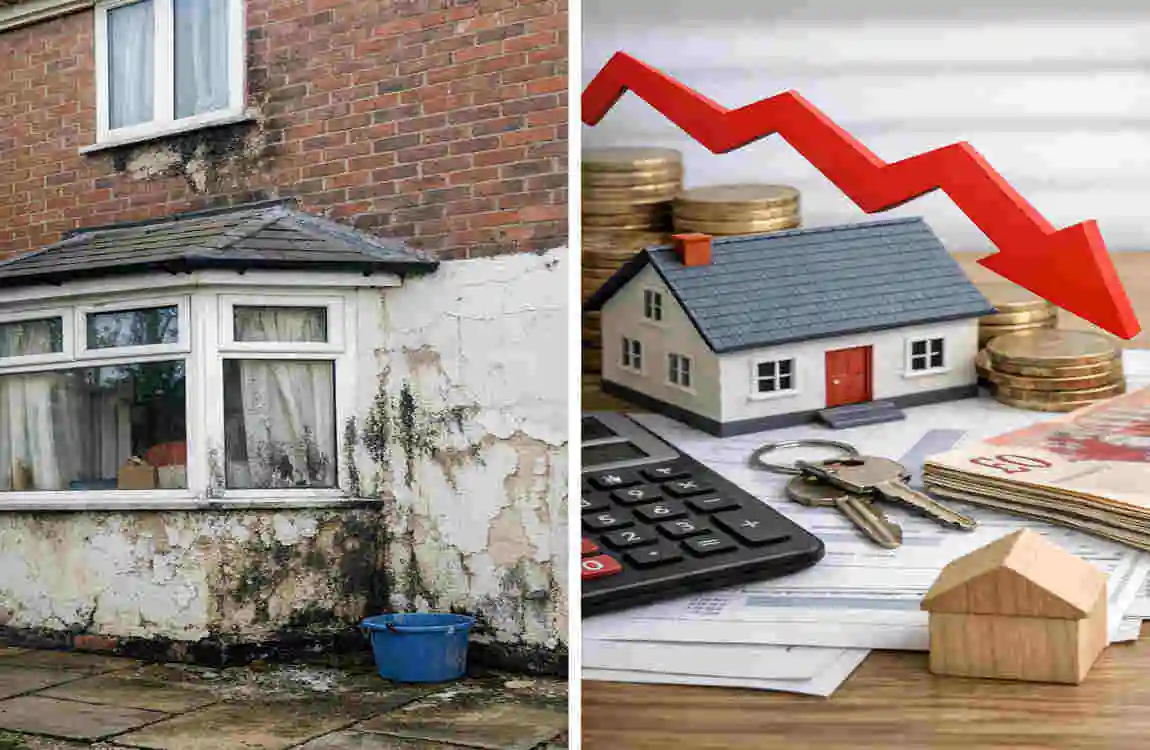
If you are planning to sell your property this year, you might be staring at that ugly black patch on your living room wall and wondering about the financial consequences. You are not alone. With the relentless wet weather we experienced throughout 2025 and into 2026, moisture problems are at an all-time high across the country. But how much does damp devalue a house in today’s market?
The short answer might shock you. Depending on the severity, damp can slash your property’s value by 5% to 50%. For the average UK luxury home, that means a devastating financial loss of between £20,000 and over £100,000.
UK Housing Crisis and Damp Risks
The UK housing market has faced tremendous hurdles recently, but nothing has scared buyers quite like the lasting effects of the extreme weather in 2025. Record-breaking rainfall and widespread flooding have left a lasting mark on our housing stock.
Currently, industry experts estimate that 1 in 5 UK homes suffers from significant damp. This means that if you are putting your house on the market, you are selling to a hyper-aware audience. Buyers are walking through your front door, actively sniffing the air for that telltale musty smell.
When a buyer books a surveyor, you can bet that damp is the very first thing they look for. In fact, recent property surveys flag damp as the number one deal-breaker for buyers in 2026. Buyers do not want to inherit a problem that could cost them thousands of pounds to fix, let alone the health risks associated with black mould.
If a surveyor finds evidence of moisture, the buyer will almost certainly drop their offer or pull out of the sale entirely. Mortgage lenders will often hold back a portion of the loan—known as a retention—until you fix the problem.
So, how much does damp devalue a house under these stressful conditions? In minor cases, you might lose a few thousand pounds. But in severe cases where the building’s structural integrity is at risk, you could see your property’s value plummet by up to 50%. The current housing crisis means buyers hold the power, and they will absolutely use a damp patch to negotiate your asking price into the ground.
Types of Damp Impacting House Value
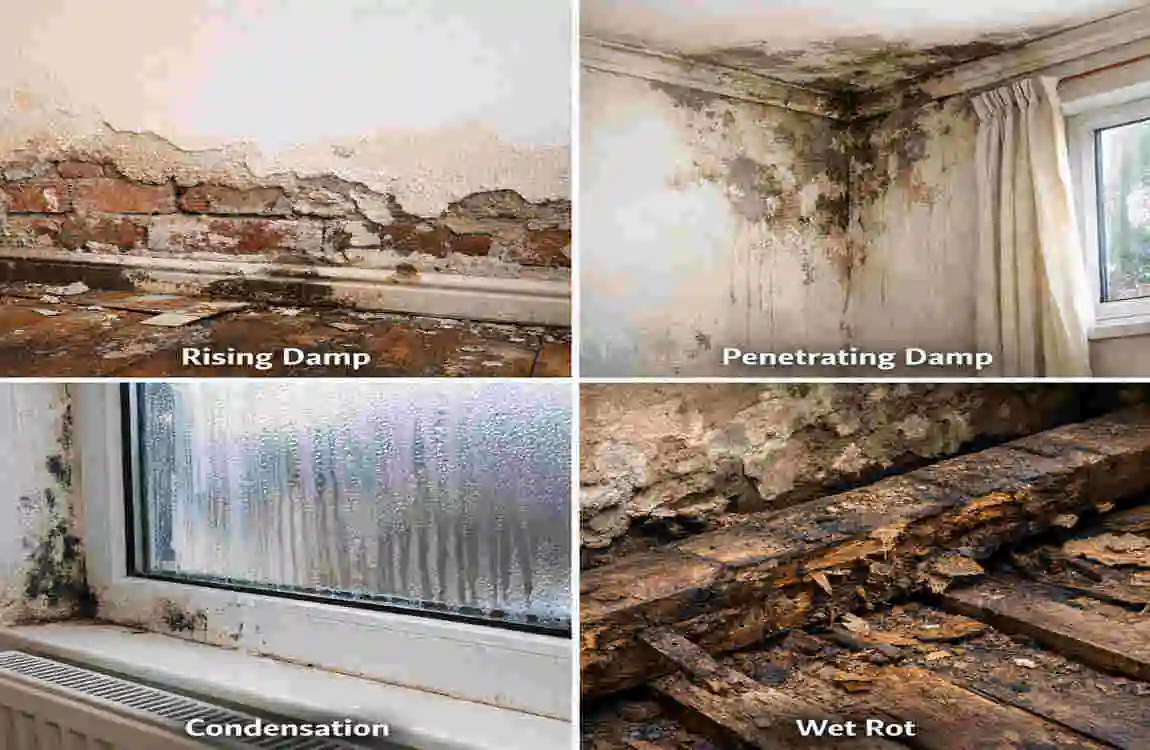
Not all damp is created equal. The source of the moisture dictates how difficult it is to fix, and therefore, how much it will hurt your asking price. Let us break down the three main culprits destroying modern home values in 2026.
Rising Damp Effects
Rising damp happens when water from the ground travels up through the bricks and mortar of your home. Think of your walls acting like a sponge sitting in a puddle of water. This usually happens because the building’s original damp-proof course (a waterproof layer built into the wall) has failed, bridged, or was never installed in the first place.
You will typically spot rising damp as a distinct “tide mark” on your downstairs walls, usually peaking about 1 meter above the skirting boards. You might also notice peeling wallpaper, crumbling plaster, and rotting skirting boards.
Because rising damp is incredibly common in older period homes (such as Victorian and Edwardian terraces), buyers often expect it. However, expecting it does not mean they will pay full price. If a surveyor spots rising damp, you can generally expect a 10% to 20% devaluation on your property. Buyers know they will have to strip the plaster back to the brickwork, inject chemical barriers, and re-plaster, which is a messy and disruptive job.
Penetrating Damp Damage
If rising damp comes from the ground up, penetrating damp comes from the outside in. This occurs when water seeps through the exterior of your house. Missing roof tiles, cracked exterior render, overflowing gutters, or poorly fitted windows all invite water straight into your living space.
Penetrating damp is heavily penalized in valuations. Why? It often points to a larger, more systemic issue with the building’s maintenance. If water has been leaking through the roof for months, there is a high chance that the hidden structural timbers are rotting.
This type of moisture brings the terrifying prospect of wet rot and dry rot. Because the potential repair bills are basically an unknown black hole until builders start tearing down walls, buyers run for the hills. Penetrating damp causes the worst valuations by far, often leading to a massive 20% to 40% drop in your home’s worth.
Condensation Concerns
Condensation is the modern homeowner’s paradox. We spend thousands of pounds installing double glazing, thick loft insulation, and draft excluders to keep the heat in and lower our energy bills. But in doing so, we trap all the moisture we create inside.
Every time you boil a kettle, take a shower, or even breathe, you release water vapor into the air. If your house cannot breathe, that vapor turns into water droplets on cold surfaces, like windows and exterior walls. Over time, this breeds toxic black mould.
While condensation is usually the easiest and cheapest damp issue to fix—often just requiring better ventilation—it still looks terrible to a prospective buyer. A wall covered in black spores screams “problem house.” Even though it is easily remedied, condensation can still cause a frustrating 5% to 15% hit to your home’s value simply because it scares people away.
Damp Types vs. Devaluation %
Here is a quick breakdown of what you stand to lose, and what it roughly costs to fix the issue before you list your house.
Damp Type Average Devaluation Estimated Repair Cost
Rising Damp 10% – 20% £5,000 – £10,000
Penetrating Damp 20% – 40% £10,000 – £30,000+
Condensation 5% – 15% £500 – £3,000
How Much Does Damp Devalue a House? Key Stats
To truly understand the financial damage, we need to look at the hard numbers. When people ask, “How much does damp devalue a house?”, they want to know the pound-stereotypical reality. Let us use the current average UK house price of roughly £300,000 to illustrate the devastating financial impact of ignoring moisture problems.
Mild Damp: The Annoying Profit Killer
Mild damp usually includes small patches of condensation, a slight musty smell in a bathroom, or a tiny patch of peeling paint near a window. You might not think it is a big deal, but buyers will.
For mild issues, you will typically see a 5% to 10% reduction in value.
- The Financial Hit: On a £300,000 home, this means losing between £15,000 and £30,000. Buyers will use these small issues to haggle your price down, claiming they need a “buffer” in case the problem is worse than it looks.
Moderate Damp: The Mortgage Threat
Moderate damp includes visible tide marks from rising damp, localized patches of penetrating damp from a leaky gutter, or extensive black mould in multiple rooms. At this stage, surveyors will absolutely flag the issue in big red letters on their report.
For moderate issues, expect a brutal 15% to 30% drop in your asking price.
- The Financial Hit: On a £300,000 home, you are looking at a loss of £45,000 to £90,000. At this level, some mortgage lenders will refuse to lend the full amount to the buyer. They will hold back funds until the damp is professionally repaired, which often causes the entire chain to collapse.
Severe and Structural Damp: The Unsellable Property
Severe damp means water has actively destroyed the bones of your house. We are talking about extensive dry rot in the floor joists, crumbling structural brickwork from long-term penetrating damp, or a flooded basement that has never been tanked.
For severe damp, the devaluation sits at 40% to 60%—if you can sell it at all.
- The Financial Hit: On a £300,000 home, you could lose up to £180,000. Properties in this condition are generally considered “unmortgageable.” Regular buyers cannot get a loan for them, meaning you are restricted to selling to cash buyers and property developers at a massive discount at auction.
Regional Data: Does Location Matter?
Interestingly, the penalty for damp varies depending on where you live in the UK. In London and the South East, where property prices are exceptionally high, and buyers demand Premium finishes, the percentage drop hits much harder. A 20% drop on a £700,000 London terrace is a life-changing amount of money (£140,000).
In the North of England, where terraced housing stock is older, and buyers are more accustomed to basic renovations, the percentage drop tends to sit at the lower end of the scale. However, the wet weather trends of recent years are rapidly closing this regional gap, making buyers everywhere much more cautious.
Factors Amplifying the Loss
Several external factors will make your damp devaluation even worse:
- Age of the house: Buyers forgive a little damp in a 1900s cottage. They will show absolutely no mercy if an aggressive damp patch appears in a home built in 2015.
- Surveyor reports: If the surveyor uses words like “structural,” “urgent,” or “widespread rot,” buyers will run. The language used in the survey dictates the buyer’s fear level.
- Market conditions: In the slower, cautious market of 2026, buyers have their pick of properties. If your house has damp and the one down the street does not, they will buy the other house rather than take on your problems.
Real UK Case Studies: Damp Devaluation Examples
Numbers and statistics are helpful, but nothing paints a clearer picture than real-world stories. Here are three recent examples from the 2026 UK property market that perfectly illustrate how much damp devalues a house.
The Victorian Semi-Detached Disaster
Sarah and Tom owned a beautiful 1890s Victorian semi-detached house in Manchester. They listed the property for £400,000. During the viewings, buyers loved the high ceilings and original fireplaces, but they quickly noticed the distinct smell of damp and a faint tide mark in the hallway.
The highest offer they received was £300,000—a massive 25% drop, equating to a £100,000 loss. The buyer’s surveyor had flagged extensive rising damp and suspected wet rot under the floorboards.
Instead of taking the massive hit, Sarah and Tom pulled the house off the market. They hired professionals to remove the old plaster, inject a new chemical damp-proof course, replace the damaged timber, and re-plaster the walls. The total repair bill came to £15,000. Six months later, they re-listed the house with a clean bill of health and a 10-year damp guarantee. They sold it for £410,000. By spending £15,000, they rescued £110,000 of lost value.
The 1980s Bungalow Trap
David inherited a 1980s bungalow in Cornwall and decided to sell it quickly. The property had been rented out for years. When David inspected it, the bedroom corners were covered in thick, black condensation mould. The tenants had rarely opened the windows and routinely dried their clothes on the radiators.
David listed the bungalow for £250,000, assuming buyers would wash the walls. He was wrong. Viewers were disgusted by the mould, assuming the roof was leaking. The best offer he got was £220,000—a 12% devaluation.
Realizing his mistake, David spent just £1,500 installing an intelligent Positive Input Ventilation (PIV) unit in the loft to circulate fresh air, and he thoroughly cleaned and repainted the walls. The mould never returned. He re-listed the home and achieved his full £250,000 asking price.
The New-Build Nightmare
New-build homes are supposed to be perfect, but Rachel’s 2020 detached house in Surrey proved otherwise. Poor construction details left her exterior render cracking, allowing intense penetrating damp to soak through her living room wall.
Despite the home technically being under a warranty, the developer was dragging their feet on the repairs. Frustrated, Rachel tried to sell the home as-is for £500,000.
Because the house was so new, buyers were utterly terrified by the penetrating damp. They assumed the entire structure was fundamentally flawed. Offers came in at just £325,000—a brutal 35% hit. Rachel realized she could not sell until the developers fixed the exterior rendering and the internal walls. It took a legal battle, but once the penetrating damp was finally fixed, the house regained its full value.
Repair Costs vs. Value Recovery
When you face damp issues, you have two choices: sell the house cheaply and take a massive financial hit, or spend the money to fix the problem and recover your property’s value.
In almost every single scenario, fixing the damp before you list your home is the most financially sound decision you can make. Let us look at what it actually costs to fix these issues in 2026, and how much value you get back.
Average UK Damp Proofing Costs
The cost of your repairs will entirely depend on the type of damp and the size of your property. Prices have risen slightly due to inflation and material costs over the last few years, but professional damp proofing remains highly accessible.
- Chemical Injection (Rising Damp): This is the most common fix for rising damp. Technicians drill holes into your mortar joint and inject a water-repellent cream that creates a new barrier. You can expect to pay around £2,000 to £8,000 per room, largely because you must factor in the cost of removing the old, damp plaster and re-plastering the walls with a special salt-retardant mix.
- Structural Repairs (Penetrating Damp): If you need to fix a leaking roof, replace cracked brickwork, or install new guttering, prices vary wildly. A simple gutter fix might cost £300, while a new roof could cost £10,000.
- Tanking Membranes (Basements and Cellars): If you have damp below ground level, you need “tanking.” This involves applying a waterproof coating or installing a dimpled membrane system with a sump pump to physically block water from entering the room. This is Premium work, usually costing between £40 and £80 per square meter.
The Return on Investment (ROI)
Does spending this money actually work? Absolutely. Having a professional damp proofing certificate, backed by an insurance guarantee, completely neutralizes the buyer’s fear.
When you present a clean, dry house with paperwork proving that the damp has been eradicated, you effectively eliminate the devaluation penalty. You can typically expect an 80% to 90% value regain post-fix.
Repair Type, Estimated Cost, Typical Value Recovered
Chemical Injection £5,000 85% – 95%
Basement Membrane Tanking £20,000 90%+
Ventilation Systems (PIV) £1,500 100%
Remember, buyers, overestimate the cost of repairs out of fear. By removing the unknown variable from the equation, you protect your bottom line.
Prevention: Avoid Damp Devaluation
The best way to deal with damp devaluation is to prevent the damp from occurring in the first place. You do not need to wait until you are ready to sell to protect your most valuable asset. A few simple, proactive maintenance tasks can save you thousands of pounds down the line.
Master Your Ventilation
As we discussed earlier, modern homes suffer from significant moisture problems. You need to let your house breathe. Make sure you use extractor fans in your kitchen and bathroom every time you cook or shower. Keep them running for at least 15 minutes after you finish. Open your windows slightly (use the trickle vents if you have them) to allow cross-ventilation.
If you dry clothes indoors, always do it in a closed room with the window open, or invest in a dehumidifier. These small lifestyle changes eliminate condensation.
Keep Up with Exterior Maintenance
Your house is your fortress against the British weather. Once a year, preferably before winter sets in, walk around the outside of your property. Look up at your roof to check for missing tiles. Inspect your exterior walls for cracks in the brickwork or rendering.
Most importantly, clear your gutters! Blocked gutters cause rainwater to spill over the sides and cascade down your exterior walls, leading directly to penetrating damp. A £50 gutter-cleaning service can prevent a £10,000 penetrating-damp problem.
Embrace Smart Technology
In 2026, technology will make home maintenance easier than ever. Consider buying smart hygrometers (humidity monitors) for your problem rooms. These inexpensive little gadgets connect to your smartphone and alert you when the air’s moisture levels get too high. If your app pings you, open a window to let the wet air out.
Get a Pre-Sale Damp Survey
If you are preparing to sell, do not wait for the buyer’s surveyor to find a problem. Book a professional damp survey yourself.
As a reputable damp-proofing business, we offer comprehensive surveys for sellers. We use specialized moisture meters and thermal imaging cameras to find hidden damp before it becomes a negotiation weapon. By identifying and fixing issues early, you take control of your property’s valuation.
Market Outlook for Damp-Affected Homes
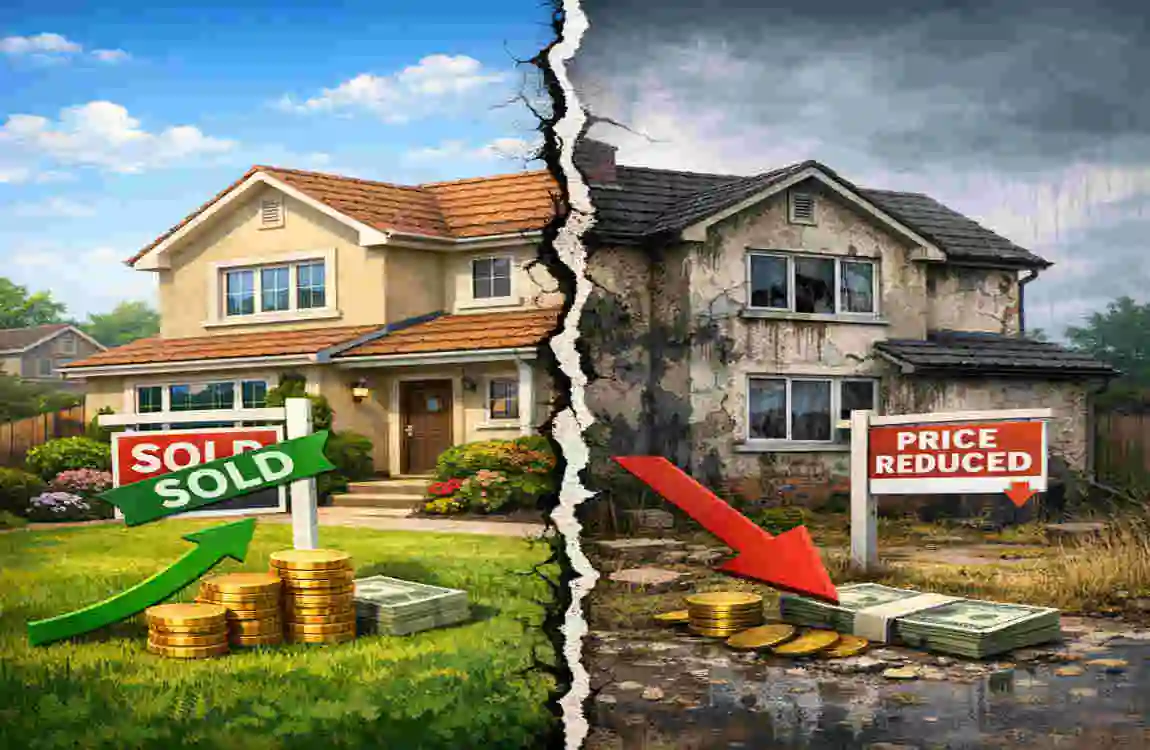
The property landscape in 2026 is uniquely challenging for homes with moisture issues. We are seeing a major shift in buyer priorities, heavily influenced by changing government regulations and environmental concerns.
With recent Labor policies strongly pushing nationwide green retrofits, buyers are laser-focused on energy efficiency. Energy Performance Certificate (EPC) ratings are now a massive selling point. However, this creates a dangerous trap for uninformed homeowners.
Many people are hastily upgrading their insulation and sealing up their drafts to improve their EPC rating before selling. Unfortunately, if they do not also upgrade their ventilation, this will immediately cause severe condensation and black mould. Buyers today are smart; they know that a high EPC rating combined with a damp smell means the house has been improperly retrofitted.
Furthermore, mortgage lenders are becoming stricter. In the wake of the 2025 floods, insurance companies have hiked premiums for homes in damp-prone areas, and lenders are demanding more rigorous structural surveys. If your house has damp in 2026, the market will not forgive you. Buyers have too much information and too many alternative options to settle for a wet house.
FAQ: How Much Does Damp Devalue a House?
How much does damp devalue a house by percentage? Depending on the severity and type of moisture problem, damp can devalue a house by 5% to 50%. Minor condensation issues might cause a 5% to 10% drop, while severe structural issues, such as wet rot caused by long-term penetrating damp, can wipe out 50% of your home’s value.
Is damp devaluation fixable? Yes, absolutely. By hiring a professional damp-proofing specialist to eradicate the problem and issue a guarantee certificate, you can completely reassure buyers. Most sellers see an 80% to 90% recovery of the lost value once the repairs are completed and certified.
Does damp affect mortgages? Yes. When a surveyor flags moderate or severe damp, mortgage lenders often place a “retention” on the loan. This means they refuse to release the full mortgage funds to the buyer until the damp is professionally repaired. In severe cases of structural damp, lenders will outright refuse to grant a mortgage, rendering the property un-mortgageable.
What are the average damp proofing costs in the UK for 2026? The costs vary heavily depending on the job. A simple ventilation fix for condensation might cost under £1,000. Injecting a chemical damp-proof course for rising damp averages between £2,000 and £8,000. Major structural repairs or basement tanking can cost anywhere from £10,000 to £25,000 or more.
